Will AI Replace Artists- or Create More of Them?
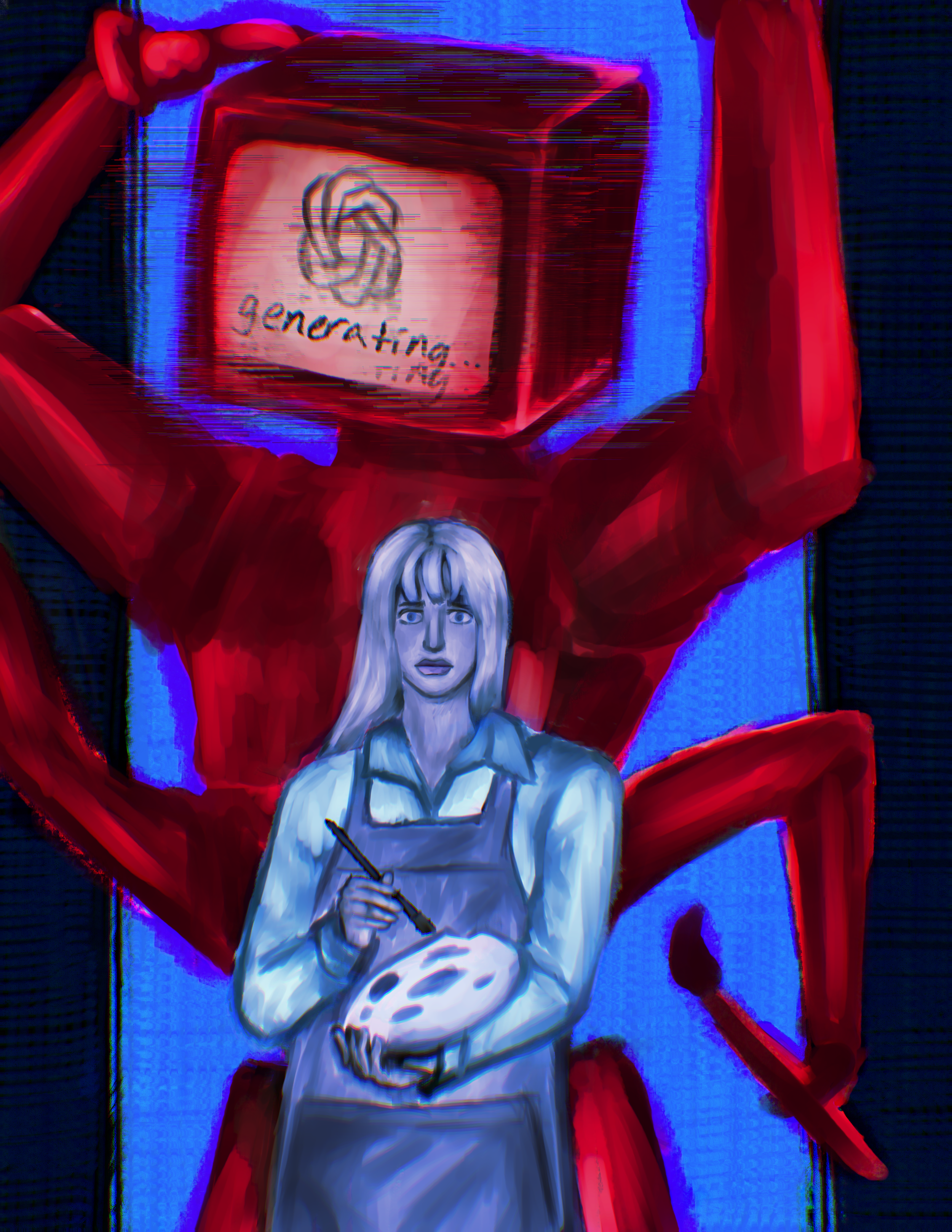
Illustration by Iman Jafrani.
Late last summer, toward the end of my internship, I was driving back from a meeting in Toronto with my boss.
We were discussing what we had been interested in lately, and my boss began talking about artificial intelligence in music—how AI could produce entire songs and potentially replace musicians.
I pushed back, asking him why we listen to music in the first place, and whether AI-produced music could actually resonate in the same way as human-made music.
These are questions I’ve been asking myself ever since the AI-generated song “Heart On My Sleeve,” which imitated Drake and The Weeknd, went viral in April 2023. “Heart On My Sleeve” was available for only a few weeks before Universal Music Group had it taken down for copyright infringement, but its millions of streams across platforms raised a troubling possibility: could AI create art that is more popular and more enjoyable than that made by humans?
Since “Heart On My Sleeve” generated controversy three years ago, we’ve seen flashes of success, but no meaningful breakthrough in the popularity of AI-generated art. In November 2024, a portrait of Alan Turing by humanoid robot artist Ai-Da sold for over a million dollars. Last summer, the band The Velvet Sundown amassed over one million listeners on Spotify in just a few weeks, before they were revealed to be AI-generated. In September, Xania Monet became the first AI artist to sign a multimillion-dollar record deal.
And yet, these moments have not added up to any cultural dominance. AI-generated songs have gone viral on TikTok, but none have become bona fide hits with lasting traction. Visual tools like Sora have generated excitement but have struggled to take off. Meanwhile, platforms like Stability AI, Midjourney, DeviantArt, and Runway AI now face class-action lawsuits from artists alleging copyright infringement.
Even so, concern among artists has only intensified. And that concern is not misplaced.
AI threatens to devalue the skills and techniques that many artists have spent years or decades mastering: the immaculate brushwork that digital artists develop only after endless hours at a tablet; the kind of finger dexterity that pianists achieve after persevering through Bach’s intricate passages; the calloused fingertips and technical fluency that guitarists build through years of repeating scales and riffs. In each case, immense time and effort are invested in reaching a level of craft that AI can now replicate in seconds. Artists may soon ask, if they haven’t already, what the point is in undertaking these pursuits when AI can produce similar results almost instantly?
AI also forces artists to contend with their own beliefs about originality and ownership. If AI combines millions of existing works to create a new piece, is it truly original? Is this any different from what artists do in their own craft, drawing inspiration from all the art they have consumed throughout their lives? And how much of their own artwork are they willing to make accessible to AI and feed into its training set?
Many great artists have long embraced imitation as part of the creative process. Picasso famously said, “Good artists copy, great artists steal.” David Bowie called himself a “tasteful thief.” French filmmaker Jean-Luc Godard observed that “It’s not where you take things from—it’s where you take things to.”
Seen in this light, it’s somewhat surprising that more artists, especially those who are well off, haven’t been more open to using AI to build on their work. Yet their resistance is also understandable. Many artists depend on intellectual property and copyright protections to make a living, and some AI-generated content has already crossed the line, replicating artists’ voices or blatantly ripping off their work.
Artists have chosen to respond to the threat of AI in varying ways. When the initial buzz around AI music first emerged in April 2023, Canadian artist Grimes announced she would allow people to use her own voice to make AI music, in return for 50% of royalties from any of the songs produced. By contrast, in 2024, artists including Billie Eilish, R.E.M., Pearl Jam, and Kacey Musgraves signed an open letter calling the unauthorized use of their work in AI training sets “an assault on human creativity" that “must be stopped.”
Given these differing views among artists, we are left to wonder what lies ahead for AI art and the value of artists’ work.
The answer, I think, comes down to what you believe the purpose of art to be, something I tried to explain to my boss as we drove back from that meeting last summer.
Do you see art as something to be enjoyed, an ornament to decorate your space and time—pretty paintings hung on walls, pleasant music playing in the background as you go about your day? Or do you see art as a unique testament to a human story, something capable of reflecting your own pain and joy, something that makes you feel less alone and helps you better understand yourself?
It’s inevitable that AI will become increasingly adept at creating beautiful works of art on its own. But it’s the human experience, and the degree to which that experience is reflected in the work, that makes art most valuable. AI will never be able to originate this itself. Because AI is not human.
Rather, it will allow more people to render their lives in artistic form, contributing to a broader democratization of art that has been unfolding alongside advances in technology in recent decades. This includes digital audio workstations becoming cheaper and more intuitive, and digital design tools lowering the barrier to entry for visual creation.
Now with artificial intelligence, songwriters are using tools like Suno to build full demos of songs they have written. Animators are using AI-assisted motion and rendering tools to streamline production. Illustrators are using generative tools like AI-assisted brushes to rapidly sketch scenes, giving them more time to focus on developing their narratives.
The use of artificial intelligence in marketing art has also allowed artists to reach audiences with unprecedented precision and immediacy. With AI tools, it has never been easier to deliver work directly to the audiences most likely to understand and appreciate it. Sure, artists may be competing with more people for attention, but they can now bypass traditional gatekeepers, with algorithms helping connect their work to audiences that would otherwise be hard to reach, whether that’s a teenager in the suburbs looking at her recommended songs on Spotify, or a high-art connoisseur in their New York brownstone shopping online for the perfect piece. This makes one of the most powerful outcomes of creation—human connection—possible on a scale we’ve never seen before.
So for those who believe the magic of art lies in mastering a lick or perfecting a brush technique, this shift may feel like a loss. The era in which artists gain recognition and fame for technical mastery may be fading. But for those who believe art is about sharing their life stories and the depths of their imagination with as many people as possible, it feels like something new is just opening up.