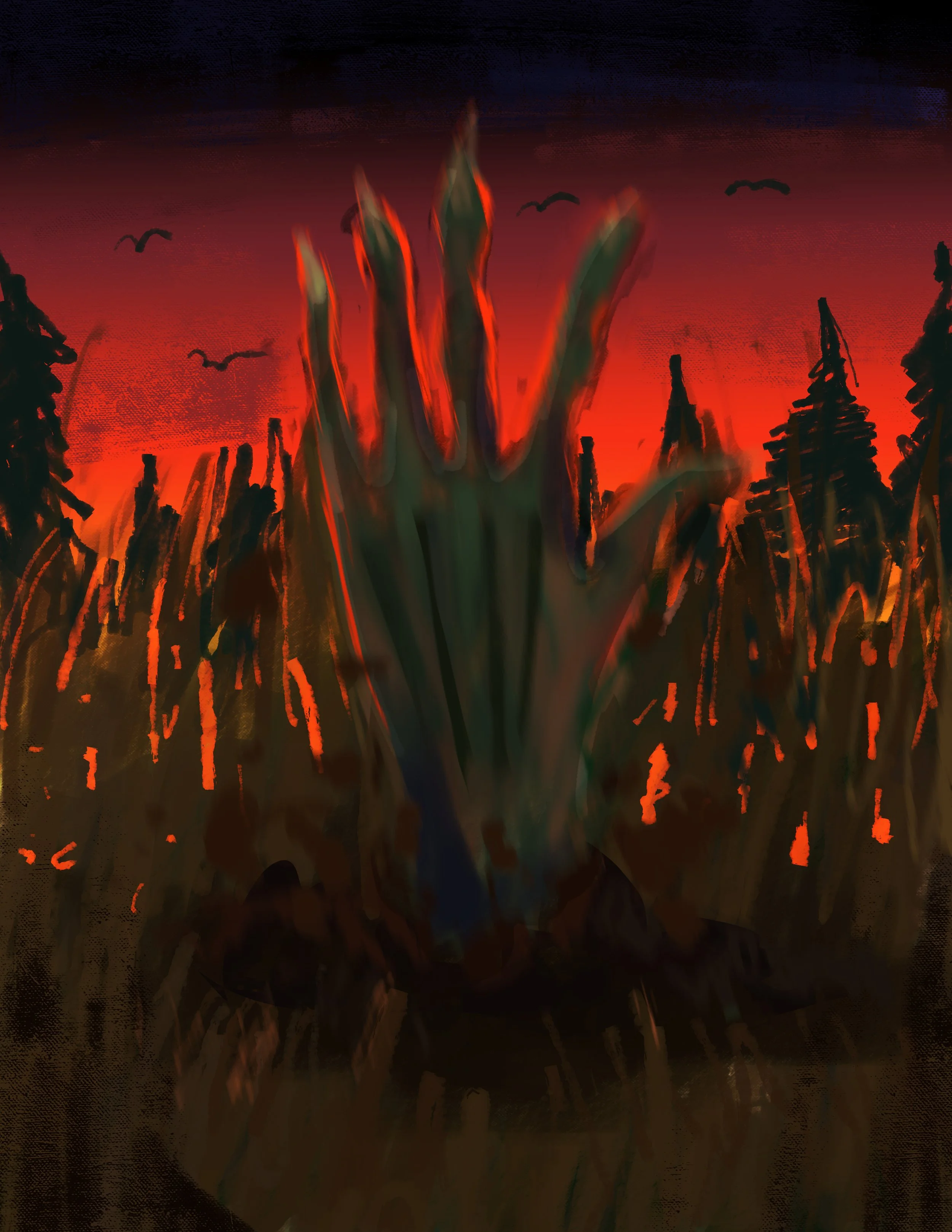
Illustration by Meghan Zhang
Once again, pop culture has resurrected the moribund zombie subgenre. It's the year of the zombie, when all of us have been consumed by these viral creatures. We all tuned in to the latest season of The Last of Us; 28 Years Later was a box-office hit; and Tina Romero's directorial debut, Queens of the Dead, just hit theatres. However, we have yet to reckon with the zombie's complex, colonial history. No, the zombie's roots do not lie in cordyceps or bioengineering, but in Haitian Vodou.
Sarah Juliet Lauro, a postcolonial literature professor, details the zombie’s history in her book, The Transatlantic Zombie. The zombie mythos descends from reanimating bodies without their souls, resurrected to perform slave labor for their masters (44). This concept of living death emerged during the Haitian Revolution, when the zombie represented “both slavery and slave rebellion,” two opposing metaphors “tempered by its irresolvable dialecticality” (29). However, the zombie-slave was buried during the U.S. occupation of Haiti, where cinema appropriated the figure to compare its loss of agency to the abuse workers suffered under capitalism (85). It’s an act of conquest that forgets “the horrors of slavery out of which the zombie originally arose” (213).
Although these zombies no longer resemble what they once were, their symbolism remains rooted in resistance because revolution boils in their blood. With this history in mind, let’s discuss some killer zombie movies to explore how they create compelling social commentaries.
28 Days Later (2002)
"People killing people, which to my mind, puts us in a state of normality right now."
28 Days Later depicts man as the monster. This unique subversion suggests that we have an unseen capacity for violence, awakened not by the rage virus, but by the lawless conditions of an apocalypse. In its opening scene, an infected chimpanzee consumes graphic content of famine, war, and riots. It warns us that when the rage virus rampages through England, it’s not the zombies we should fear. Hordes of men prey on unsuspecting survivors to fulfill desires they no longer have to suppress. They arm their survival with patriarchal violence because they cannot fathom a world where women survive too. Jim’s journey against them is a testament to holding onto one’s humanity in the wake of losing it.
Blood Quantum (2019)
"That's why the dead keep coming back to life. Not because of God. 'Cause this planet we're on is so sick of our shit."
Blood Quantum Indigenizes the zombie subgenre by exploring infection as a form of colonization. It follows the immune Mi-kmaq survivors of Red Crow, who must fight back to protect their overrun lands. They resist zombies in the most badass, blood splattering ways possible through shotguns, chainsaws, and swords to slash any threats of zombified conquest. In an interview with Seventh Row, director Jeff Barnaby explains, “In a classic horror sense, you’re supposed to be scared of zombies. But in this sense, you’re not scared of zombies; you’re scared of white people” (Heeney). Only white people are susceptible to infection, which challenges colonial oppression by depicting colonizers getting colonized; a virus seizes control of their bodies like how they stole Indigenous lands. When viral transmission colonizes the body, it becomes an infectious act of conquest that calls back to the zombie’s colonial history (Lauro 9). In Blood Quantum, we are confronted with Canada’s colonial history to remind us that we are subjugated by prejudice and have yet to liberate ourselves from its shackles.
Messiah of Evil (1974)
"We sit in the sun and wait. We sleep. And we dream. Each of us dying slowly in the prison of our minds."
Messiah of Evil follows Arletty, a young woman searching for her estranged father in a desolate California town. Despite her father’s warnings, she discovers undead salvation. While the town awaits their Messiah's return, they cannibalistically spread his gospel and perform rituals in his honour. Arletty learns that this saviour is affiliated with the Donner party. These colonizers pursued their manifest destinies into a harsh Sierra Nevada winter, where they resorted to cannibalism to survive. When Lauro examines the zombie narrative, she reminds us that enslavement is founded in colonial empires (85). Taking this into account, the Messiah’s background subtly reflects the zombie’s history, creating a complex layer to his zombified control of the town.
Sugar Hill (1974)
"I'm sentencing you. And the sentence is death!"
Sugar Hill follows a widow, Sugar, who takes revenge on the mob through an army of zombies commanded by Baron Samedi, the Vodou master of the dead. This grindhouse-revenge film belongs to the Blaxploitation movement. It is contested among critics whether the genre produces negative stereotypes of Black people, or “reshaped the narrative of Black life” through a celebration of Black culture (Spigner). In The Transatlantic Zombie, Lauro analyzes Sugar Hill to explore resistance zombies, undead who preserve their lineage by processing their historical relationship to slavery and rebellion (105). Although Sugar Hill was authored by white filmmakers, Lauro argues that it is the closest film “that comes to a reappropriation of the vodou zombie in American cinema” (104). Samedi reanimates slaves who rise from their graves still shackled, harkening back to the original zombie. They empower Sugar to avenge the love of her life, who was murdered by white mobsters after refusing to sell Club Haiti. She cathartically throws these bigots into pig pens, nails them in coffins, and tackles them with possessed chicken feet.
In a world overrun by mindless hordes inciting social injustice, we must arm ourselves with zombies to fight against oppression. When you encounter living dead, remind yourself about their history. If they represent resistance, then they can provoke revolution, returning to how the myth arose centuries ago.