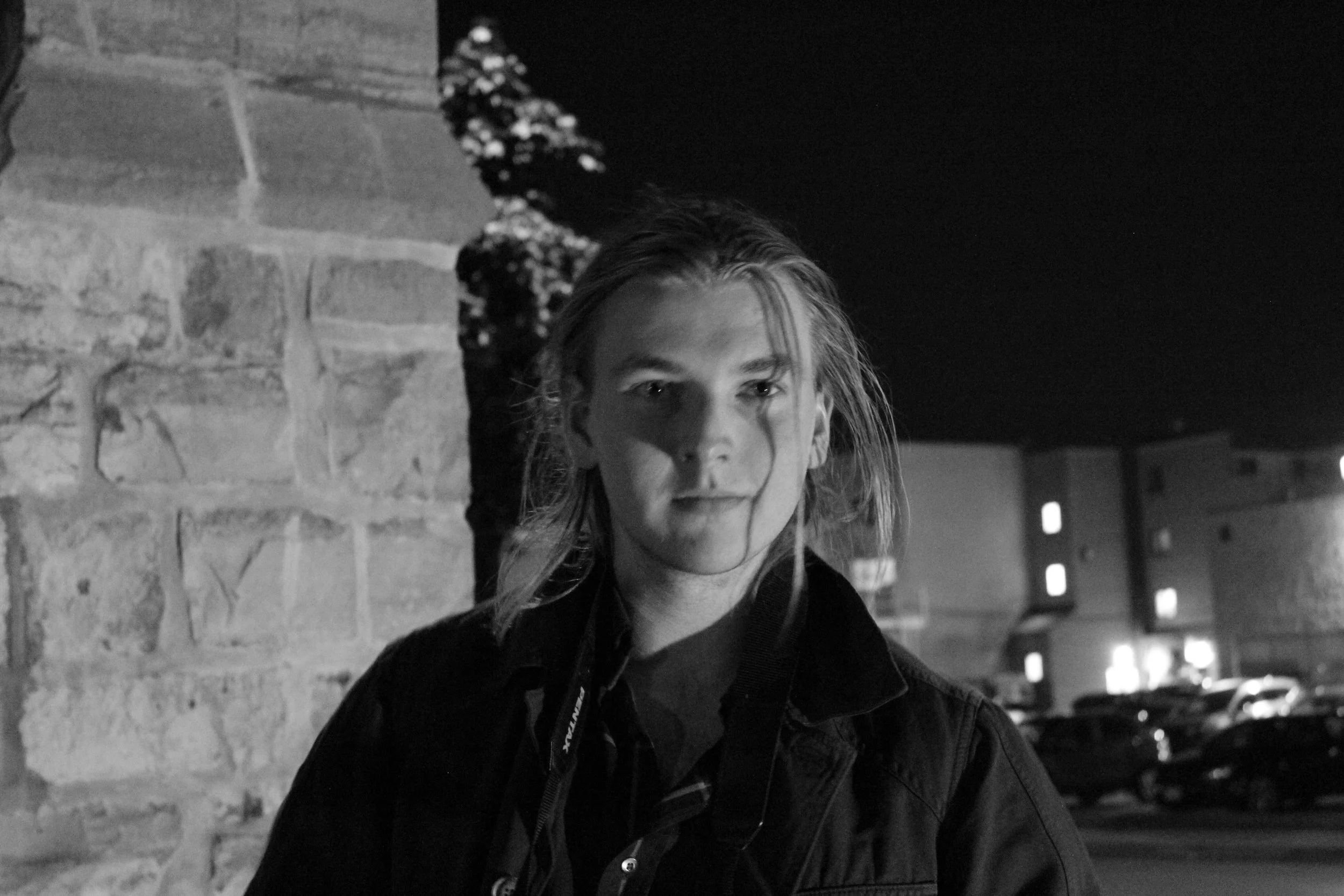
Portraits

Illustration by Baran Forootan.
No man ever steps in the same river twice. For it’s not the same river and he’s not the same man. -Heraclitus
The cool spring water rushes past me going down the stream towards Lake Superior. My boot leather holds and keeps my feet dry while the heat is slowly brought out of them by the water. I’ve been here before, in this stream, two years ago I was here, and almost two years ago to the date did I cross through this stream for the first time. As far as I’m concerned the headwaters have not changed too drastically nor has the course of the river. The river could only ever recognize me for the boots that once stamped through it and the long hair that I dipped into it. And although the boots are different and the hair is shorter than it once was, I am not so different, and neither is the river. For the roots of my hair are still the same and the bend in the river that I remember so well is still in front of me.
Things do change, but they do so slowly. Rivers meander along, ever slowly changing their course inch by inch, until finally it avulses. It still runs downstream towards the ocean and the only thing to remember the old course, what it once was, is the oxbow. We are the same, we change, bit by bit, but in the end we are still ourselves. We still flow forward through time, maintaining our course, floating towards our destiny.
Red Lake
Every time I’ve been in Red Lake someone has died.
Every parking lot in Red Lake is full of trucks, and every one of those trucks is backed into a parking spot. In the mine the first thing you are taught, before you even put the truck in drive, is to always back in wherever you park because the first direction you should be moving in an emergency is forward. Red Lake is a mining town down to its core and you can see that even in the littlest things.
Every time you drive from Balmertown into Red Lake you pass the mine rescue station. The white trucks with their red lights and logos. Since 1929 those red lights have gone flashing into the darkness of the Earth in the hopes of saving lives, but it isn’t always enough.
On a sunny June morning I was driving from Red Lake to Madsen to go to work. On my way a white truck with flashing red lights passed me. I pulled off to the shoulder to let them pass as I would normally, and I continued on with my day. I thought little of it that morning. I went to work, I worked my line, took my samples, all the while oblivious to what was unfolding a couple kilometres to the east.
In May the Madsen mine restarted production for the first time in three years, and in June it had already claimed another life. Mining is dangerous, when the lights go out underground and you are left sitting in the darkness beneath the hot, shifting, creaking Earth, you can understand truly, what it means to be in hell.
In 1926 the mining boom in Red Lake started. First came the prospectors, and then came the floatplanes. You can hear it across Howie Bay when the jet engines click to life and roar away into the clouds. Flying in a floatplane is a peaceful experience. Carried on the wind you look down at the lakes calmly passing by beneath you. The poplars, and pines wave to you as the breeze gently brushes through them. Landing and taking off however are different stories. In a second you are reintroduced to the violence of the water as the waves crash against the floats and then, you are standing upon a black abyss, two degree water slowly undulating beneath your feet, begging you to enter their depths to join the ever growing graveyard of floatplanes beneath the surface.
When planes crash they don’t just fall out of the air. The feat of flight is one that is difficult to achieve, but when a plane is in the air it is safe. It is guarded by the trade winds and hidden from danger in the clouds. Instead it is the bridging of worlds that presents the danger. Pilots fight against the wind, the waves, and the ever present force of gravity, and they don’t always win. A year ago a De Havilland beaver took off from Howie Bay. It was a routine flight, taking a couple of fishermen to a small lake to fish. There was a moment when that pilot lost the fight, gravity took hold of his plane and it came crashing down into the cold depths of the lake.
There is a red tinge to the water of the lake, which is where the name comes from. A long time ago, two Chippewa hunters came across a large moose on the shore of the lake. This was the largest moose the two hunters had ever seen, and in their hunger they unleashed a full quiver of arrows upon the moose. It was too big for them to quarter, too big for them to eat and so it lay there on the shore of the lake and it bled. Its blood flowed into the lake and it forever sullied it, leaving behind it a bloodstained shore.
This is the story of Red Lake, there is no other story, there could never be another story. The story of Red Lake is the story of abundance. The highest grade gold mine in the world is in Red Lake. There is so much gold in Red Lake that if you dig through the gravel in the parking lots for long enough you will find it. People from around the world come to Red Lake to hunt the land and fish the lakes for it has some of the biggest moose and walleye in the world. Death is also abundant here. Whether it be hunters, pilots, miners, or prospectors, death looms over the town, it looms over the people.
Milton
The wheels slam into the runway and the white smoke of burnt rubber bursts into the air. The airconditioning on the flight is broken and I have been rapidly reintroduced to the 28° heat of the Toronto evening. I take my things and get off the plane, a cool breeze is rushing in from lake Ontario and my ride home is waiting for me in the phone lot.
Home is a complicated statement for me. Home sits on my mind like a heavy ball of lead as I rocket down the 401 supposedly towards it. I was born in Milton, Ontario, it is my hometown but it’s been a long time since it’s been home to me. As I approach the town, the wheat and cornfields from my childhood have seemingly been swept away by the slow growth of the suburban homes. Mattamy and their bulldozers have flattened the land, they have turned the greens and yellows to greys and beige. For a time, Milton was the fastest growing town in Canada. The roads spread outwards like the veins of a humming, pulsating tumor. It pushed up against the escarpments slopes and surged through the valley. The forests were cut away, the grass was mowed down, and the rivers were bloated and turned into drainage ponds. Eventually in its quest for growth the town started to cannibalize itself. The factories, the car dealerships, the restaurants were all thrown away, and in their place, the cookie cutter houses built in a way which is designed to maximize profit margins.
There was an old factory in Milton. It was the industrial part of town, I don’t know when it was shut down but for me it had always been the old abandoned factory. They used to make shock coils there, it was a big job producer in town and when it shut down I think Milton stopped being home for a lot of people. As it sat empty the remaining Miltonians started to reclaim it. Graffiti popped up on the walls and ladders to the roof appeared, ladders that if followed allowed one to sit on the roof and watch the highway, and the escarpment. It was a nice place. When they tore it down a few years ago to make way for more office and warehouse space Milton stopped being home for me.
Is time linear?
It seems like a stupid question, any physicist will tell you that entropy cannot be reversed, the universe marches towards a state of lowest energy and so t approaches infinity and yes time is linear. And while in the bounds of a physics question yes time is linear, but is our time linear.
There is a small turnoff on Steeles road at the top of the escarpment. This is a spot that I have loved since I was a kid. I am sitting there now watching the lights of the town twinkle softly in the oncoming dusk. I am standing beside myself, he stands there, 6 months ago smoking a cigar in the cool winter air with a good friend as they ponder heartbreak. Beside him, with the warm spring sun shining on his face is me. 2 years ago with a hand-me-down digital camera that he is experimenting with, catching pictures of the sunrise. Behind us all, there is a young man and a young girl. Together they are painting the spring blossoms and the young man still does not know that in the coming months he will fall deeply in love with that girl. To my left is a stranger to me. He is older than I and he stands there in silence bidding a farewell to the city that he once knew so well.
Time coils up inside of us. It wraps around our insides and ties itself in knots. Each intricate weave, a point of weakness where time bleeds together. Whether it be old ice cream parlours, old haunts, a friend's basement, or a scenic lookout, it is in these places that time sits heavily on my mind. The weight of it all makes it unravel and I can see through the weave, looking back to what I once was, and forward to what I will be.
I don’t know if this is normal. I try to communicate this feeling with others but it never quite lands. I wonder often if maybe I am just haunted. Maybe I just live in a world with ghosts only I can see. I saw a ghost today, she floated down the sidewalk in a black dress, melting away into memory in the summer heat. Tonight I will lay beside a ghost, I will lay beside many ghosts, many of whom still think of Milton as home and are looking toward the brighter future, the future that I now inhabit.
Atikokan
I’m back in Atikokan again. I drove west of Thunder Bay underneath the beating sun and I am now once again greeted by the muskeg. The sprawling farmland of Thunder Bay and Fort Frances are intermittent pockets nestled away in the ever growing, ever consuming swamp. There are grey clouds on the horizon, a rarity in this place that is so often hot and dry. The rainclouds arrived at my cabin earlier in the evening and now I sit here writing this portrait listening to the pitter-patter of raindrops against the logs that surround me.
Atikokan is the closest thing I have had to a home when I work. I have travelled across Ontario and even into the territories for work but for the last three years I have always ended up at some point here, back in Atikokan Ontario, more specifically, the now abandoned town of Sapawe. This place was once a bustling town, back when steep rock was still in production and people still took highway 11 across the country. Now when you drive across the land all you see are moose and the odd black bear. Haul trucks are sporadic and travellers are even rarer.
Ontario is an immensely tragic place. When one thinks of Ontario it is often of Toronto, of the limestone that makes up the Niagara Escarpment, some think of Ottawa and the St. Lawrence, or of the old stone buildings of Kingston Ontario. Almost none will think of the blood red rocks of the steep rock mine, none will think of the abandoned bowling alley turned flower shop with wilting flowers strung up outside of it. There are so few to think of the slumped roof of the general store in Sapawe beside the last remaining mill, or the for sale sign in front of the high school.
There, for me at least, is an anger imbued in the land here. You walk alone in the empty streets as the pavement crumbles underneath your feet and the sun beats down on you. The empty stores peer at you through their shuttered windows and they ask you one single profound question, they ask you why? Why have they been forgotten, why do they sit there and waste away, why was the promise of prosperity not delivered to them. And the only answer you can give is that, it’s just the way that it is. Canada is an immensely tragic place, by the time Toronto has cast their votes it’s already over, there is no one to look after the north.
So it goes.
There is a story my boss likes to tell. The story goes that he is called down to Toronto to act on a board for the development of northern Ontario. He enters this meeting and sat around the table with a handful of northerners, but for every northerner there are three people from southern Ontario. They hold a vote on some mundane bureaucratic thing and almost all of the southern Ontarians are in opposition. So my boss asks the man opposite him, a man from Toronto, a man dressed in fancy clothes and well groomed. He asks the man,
What's the furthest north you’ve ever been?
And the man responds,
Barrie.
This is the tragedy of northern Ontario. There is a beauty here that none of those who govern it will behold. It is easy to look at it and call it a backwater, and it is even easier to say that when you have choked back your seventeenth black fly and have pulled the third wood tick out of your pants, but then you come out of the swamp. You work your way up a mossy hill, you slip on the cyan moss and learn quickly to only step on only the green. You step over geologic features that have been burned into the rock by the oldest mountains on the continent and you step out into the breeze. A lake extends before you, one virtually untouched by any man except for the voyageurs and trappers that came before you. The breeze blows the blackflies and mosquitoes away, and the moss that you were just slipping on provides a comfortable place to sit. You eat your peanut butter sandwich, but leave your apple, for it would feel wrong to eat the forbidden fruit in a place that so closely resembles Eden, and you sit in silence.
The mills across the north shore of Superior are silent these days. The mines have all been flooded, and now all that remains is the stories of what once was. These places, this place, this ghost town, mean a lot to me. This place represents so many parts of my life that I hold so near and dear to my heart. And someday, it will be gone.
I met a man in a minivan once. Normally a minivan wouldn’t be out of the ordinary but 20 km up a logging road a grand caravan is a bit odd. He was an older man, we talked briefly. He said he was looking for Quetico, the old ghost town. His mother was a teacher there, and it was there he was raised. In the old town, with the old train station. He was on his way there in remembrance of his late brother who had grown up beside him in that now forgotten town. I gave him directions and wished him on his way telling him that I’d check back in the morning to make sure he was ok.
I never did see him again.
So it goes.