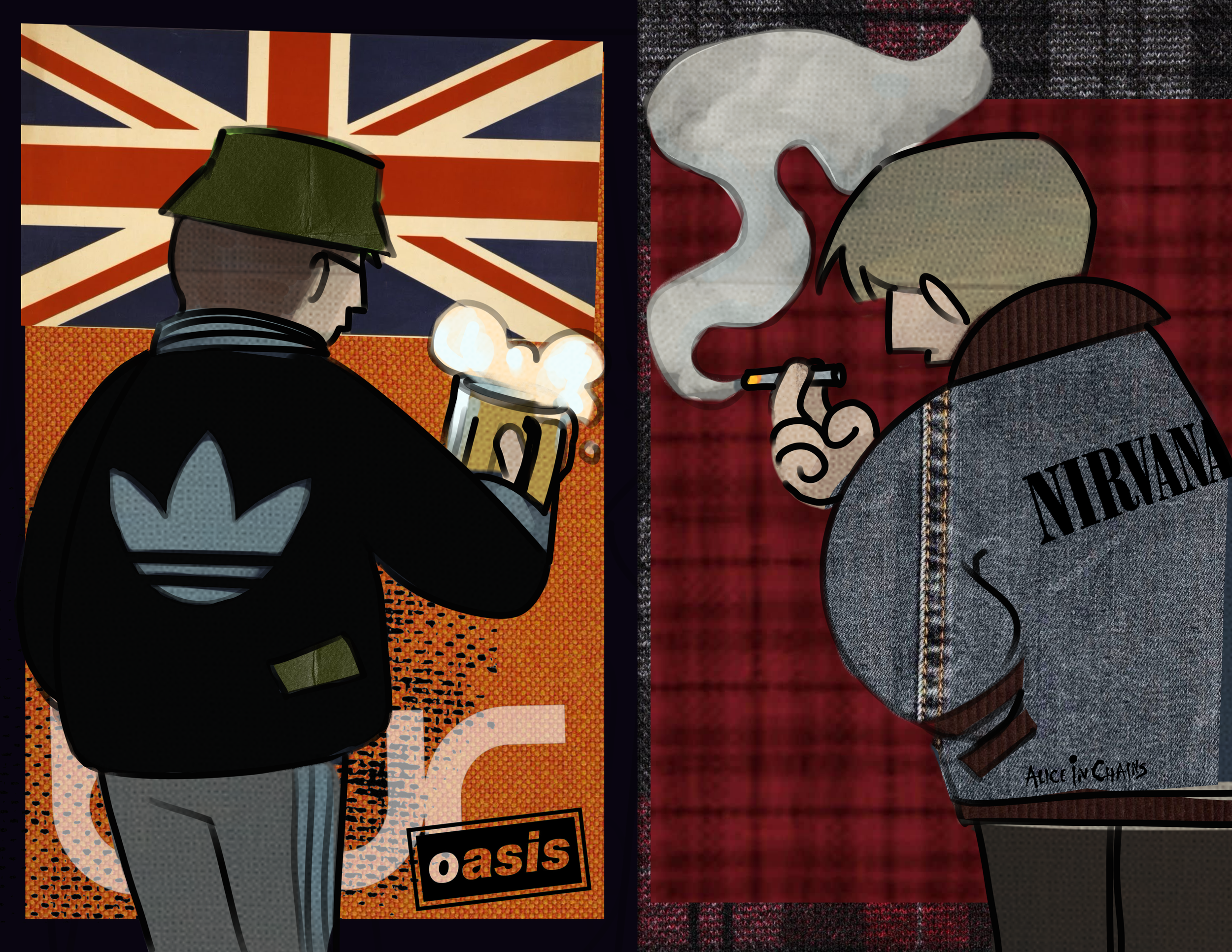
Illustration by Jayda Korn.
Imagine being a teenager during the 1990s. Our Gen-X parents were in the midst of a cultural explosion, with music being a prominent part of the experience. A new genre seemed to appear every week, ranging from Gangsta Rap, and Pop Punk, to Neo-Soul. This period warrants attention towards the very divisive conversations happening around Grunge and Britpop; It was England vs. the USA, upbeat melodies vs. heavy distortion. This conversation continues today - which one is better?
As a huge fan of both, I have noticed that despite the differences in musicality, the attitudes in each movement are the same. Both arose from ordinary people during difficult times in their nation’s history, making music to resonate with young people struggling to make things work. Let's take a dive into the history of each genre, to learn why they both rock, and ponder on their similarities.
WHAT IS GRUNGE?
Grunge was born during the late 80s in a rock-starved, blue-collar Seattle. The Pacific Northwest was mostly a dead-zone for bands on tour because of its isolation and lack of fans. Working class citizens of Washington State were no longer impressed by the excess and theatrics of Glam Metal, which was just coming down from its peak of popularity. Seattle-based musicians began to create their own scene in the midst of this musical vacuum. From their garages, homes, and small recording studios, this was the birth of the “Seattle Sound”.
Characterized by its influences of metal and punk with a focus on distortion and experimental sounds, songs could have complex rhythms with shredding guitar solos like Soundgarden, or follow simpler chord progressions with catchy riffs like Nirvana. A common theme across all bands were the famously depressing lyrics that made way for the rise of grunge.
WHAT IS BRITPOP?
Britpop is supposed to be the antithesis of grunge - a huge part of its origin was to counter grunge’s doom and gloom. In an interview with NME, Damon Albarn of Blur famously said, “If punk was about getting rid of hippies, then I’m getting rid of grunge.” Bands on the scene brought a more upbeat version of alternative and independent music to the table, focusing on British working class life, struggles and celebrations. Pop-culture in Britain is infamous for its nasty tabloids, soccer hooligan antics, its North vs. South rivalry, and many more, most of which is unfamiliar to the North American market. Britpop artists utilized this niche to create a relatable experience for UK listeners.
Inspiration was taken from archetypal British music from the past few decades: from the punk scene of the 60s and 70s, and from the Beatles, to the glam rock of David Bowie’s time, and to the jangly sound from The Smiths. There is a quintessential upbeat sound, and the lyrics focus on the ups and downs of British life.
Though there seems to be a lot of division between the scenes and fans of these two genres, you can’t deny that they share many themes. America had Reagan and Britain had Thatcher, two leaders that greatly affected the lower and middle classes of their countries. It is no surprise that young people were feeling jaded and hopeless (much like the current situation today!). Social and personal issues were common lyrical themes making sense of the intersection between these two genres that were shaped by similar social pressures.
POLITICS
Grunge may not seem like the most political genre at first glance, but many of the defining artists had strong views that bled into their music. Kurt Cobain of Nirvana frequently spoke about feminism and LGBTQ+ rights, and did not waiver in his beliefs. “Rape Me” was a controversal song because of its title, but is a strong and meaningful statement against rape culture. It was composed after many fans didn’t fully understand that one of their other songs, “Polly”, was speaking out about violence against women. Kurt Cobain decided to be more explicit in his lyricism. The narrator in the song is passive but vengeful, and the lyric “I’m not the only one” is one of solidarity with victims. “Polly” itself is about a real victim, a fourteen year old girl who was kidnapped in 1987. These songs both have some shock value to them, an aspect that draws attention. The message is clear from the beginning of the song. Rape is an uncomfortable topic that needs to be discussed to help prevent it from happening and provide support to victims.
From Pearl Jam, we have songs like “Jeremy,” which critiques the education system and its neglect of student mental health. “Daughter” is about a child with a learning disability, experiencing abuse by her parents. Grunge paints a picture of how politics can affect all of our lives on a personal level.
Britpop’s approach to this is through themes of class consciousness. Think “Common People” by Pulp. It discusses a rich girl wanting to mingle with “common people” and live like them, but who can always return home when things get tough. This is ironic but relevant - Gentrification is a real issue that continues to occur. A life of struggle can be glamourized, but at the end of the day, it remains as the reality for most. Along with this issue, much of Pulp’s discography explores what it means to be a young person living through late stage capitalism and the emptiness and excess it reflects. We live through an era of never ending parties and never ending problems.
Oasis has many songs about living as an aimless young person, with “Bring it on Down,” “Cigarettes and Alcohol,” and “Rock n’ Roll Star” being just a few of them. Through the lyrics, fame is seen as the ultimate escape from a life of hard work and few benefits.
In such an uncertain societal moment, it's no surprise that the most popular bands were speaking out against societal pressures through song.
MENTAL HEALTH
Mental health is one of the defining themes for Grunge. The focus was usually on alienation from society, loneliness, and depression. “Fell on Black Days” and “The Day I Tried to Live” by Soundgarden capture the experience of sudden depression, and the desire to abandon self-hatred and self-isolation while fighting internal battles. “Them Bones” by Alice in Chains ponders about death and what lies beyond. “Down in a Hole” is an honest depiction of isolation and emotional turmoil.
Britpop chooses to approach mental health through the pressures of society and the dissatisfaction that comes with it. “Country House” tells the story of a depressed city worker, fed up with his stressful life wishing to get away from it all. The same is seen in “Tracy Jacks”, with the subject of the song bulldozing his house because of his mental health struggles and exhaustion from his life. Dramatic, but effective. “The Universal” also by Blur presents an emotionally empty and depressing future, suggesting that material goods don't equal happiness.
We see some of the most famous songs pertaining to mental health emerging from both genres during this era. Grunge took it in a direction of self loathing, and introspection, while Britpop looked outward at the structures in society we deal with everyday.
DRUGS
Drug use and abuse was a common problem that both groups faced, specifically with heroin. It's a well known fact that many artists of the era suffered from addiction, with many losing their lives to it. Grunge focused on the consequences of drug use, and Britpop treated it as a temporary thrill before life comes back to punch you in the face.
Dirt by Alice in Chains is essentially an entire album about heroin addiction. “Junkhead,” “Would?” and “Dirt” are all great examples from this album, expressing the raw side of addiction without romanticizing it. Nirvana is also known for songs about substance abuse, like “Dumb” and “Aneurysm”. They reflect detachment from life and emotions instead of indulging in it.
“Beetlebum” by Blur is about Damon Albarn’s heroin addiction, and how he escaped his life with it. Almost every Oasis song from their first two albums was written on drugs or about drugs. “Columbia” by Oasis is about their experiences on acid, and how it numbed their emotions and senses.
Why were there so many drug users in these two scenes you may ask? The 1990s are known for the normalization of many drugs, especially heroin, and musicians are no exception to this trend. Sudden rises of fame coupled with untreated trauma led to an escape through drugs. Chris Cornell of Soundgarden struggled with addiction starting from 12 years old because of the abusive environment he grew up in. This issue haunted him for his entire life, up until his death in 2017. Music is a way to express any feeling or thought one has, addiction included. Trauma is persistent, and musicians are no different from anyone else when it comes to coping.
SEX AND LOVE
Love wasn’t spoken of kindly in these niches. When discussed, it was often about the messy side of things, like hedonism or dysfunctional relationships. “Heart-Shaped Box” by Nirvana and “Better Man” by Pearl Jam depict unhealthy and suffocating relationship dynamics. “Big Dumb Sex” by Soundgarden is… exactly what it sounds like. Straight to the point, with no emotional intimacy present.
Britpop observes sex and love through a gaze of irony and frustration, not sincerity. “Do You Remember the First Time” by Pulp is about a past lover the singer is nostalgically yearning for, while the lover has since moved on. “Animal Nitrate” by Suede is the story of how the singer Brett Anderson found animal-like scratches on his then girlfriend, Justine Frishmann’s back, after she cheated on him (With Blur’s lead, Damon Albarn!). Elastica’s “Stutter” is about frustration and suspicion about her boyfriend’s (Damon Albarn again…) erectile dysfunction. “Girls and Boys” by Blur explores the hedonism of 90s club culture in Britain, and the fleeting nature of intimacy in these environments.
I think that the outlooks of love for each of these genres reflected heavily on the culture in the decade. As depicted in these songs, love is cheap, imperfect and most of all, temporary. Why take it seriously and write ballads about it?
CAPITALISM STRIKES
Even though their core values were anti-establishment, both genres were heavily capitalized on. Ironically, the names “Grunge” and “Britpop” are both names given by record companies to boost sales and the whole culture war between the two was a marketable event, all overshadowing the actual music. They were repackaged into niche aesthetics and styles, pulled from the underground and onto the shelf. Many bands openly criticized these labels, as they felt it boxed them into one marketable category instead of allowing for creative freedom.
Britpop and Grunge are so fundamentally similar. They are a reflection of societal frustration that gave a voice to young people looking for creative outlets. Each genre captured the feeling of growing up in the 90s under an uncertain time. Again, I don't think asking which one is better is the key question here. The power of each genre lies in the power they gave to people who felt ignored within society, and how they are still celebrated for the same qualities today.