
Mo’ Money, Mo’ Problems

Illustration by Jayda Korn
If your TikTok and Instagram feeds are anything like mine, you would have been hearing a lot about “recession indicators” recently; indexes based on consumer behaviour that are meant to predict the beginning of economic crises. The term was initially coined in 2019 with the “Sahm Rule Indicator,” grounded in real unemployment rate statistics in the United States. Now, it has grown to include anything from patterns in search history and Big Mac prices to lipstick purchases and skirt lengths, as more and more people on social media continue to apply the consumerism patterns during the Great Depression and Great Recession to our modern-day economy. What interests me, however, is the lack of indicators for a pop music recession. While there are many indexes for lifestyle and fashion, there are not nearly as many for music, which is insane! Music is such a huge part of modern-day pop culture, so it’s baffling to me that there’s no musical index for a recession. So, I am going to take matters into my own hands and make my own. By analyzing the most popular songs from the Great Recession and finding commonalities in their lyricism, production, and themes, we can build our own list of pop music recession indicators.
For those of you who aren’t familiar with the recession I’m referencing, or who were too young to remember it well (such as myself), here’s a quick synopsis: In 2007, the United States experienced the beginning of what would be known as the “Global Financial Crisis,” in which many major commercial banks and mortgage lenders went bankrupt, federal fund rates more than quadrupled, and unemployment skyrocketed from 5% to 10% in just one year. This is what led to the “Great Recession,” the worst global economic crisis since the Great Depression following World War 2. There have been numerous debates regarding the cause of the financial crisis, none of which are unanimously agreed upon. All of which an economics student could probably explain better than I. What interests me is how the economic state of the US affected the kind of music that people were listening to. For this, I turned to the Billboard Hot 100 archives.
For this article, we’ll only be examining the Billboard Year-End Hot 100 singles from 2009, which marked the end of the global financial crisis and the beginning of the long-term economic effects it would have on the US for years to come. Here are only the top 20 of the chart:
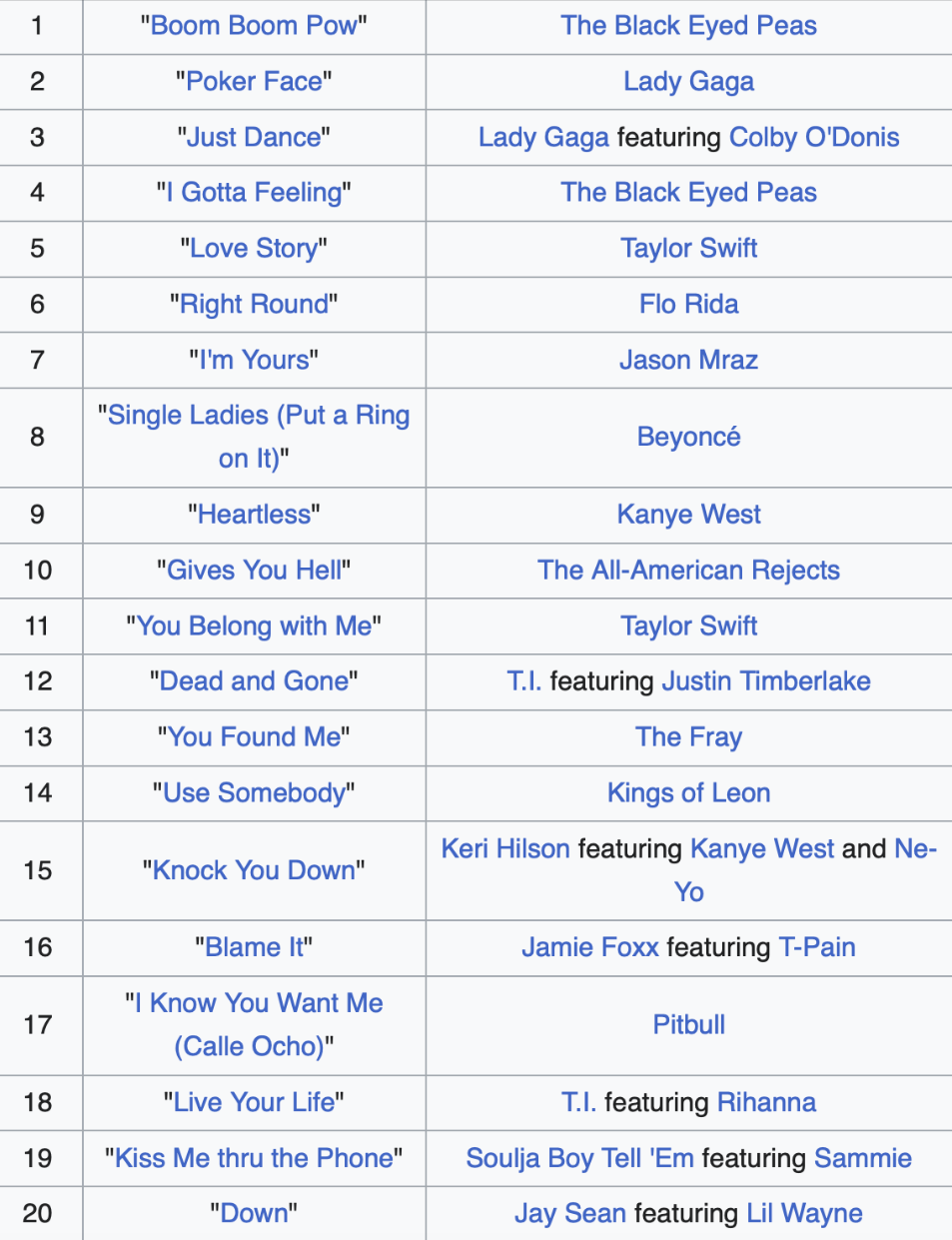
Here were some commonalities, or “indices” that I could find:
Fast Tempos Made for Dancing
The average tempo of just the songs in the top 20 of the Billboard Hot 100 is about 136 BPM (beats per minute), which is about the average tempo for dance/EDM music. Continuing down the Hot 100, we observe similar trends. Songs such as Britney Spears’ “Womanizer” and Beyoncé’s “Sweet Dreams” (which peaked at 39 and 66 on the charts, respectively) also have quicker tempos that are made for dancing along. During the recession, it seemed that slower tempos, which would naturally evoke negative, depressing feelings in listeners, were less popular than fast-paced music, which was often played in clubs or at parties.
Repetitive and Catchy
Arguably, a significant portion of the music in the top 20 consists of very simple, repetitive choruses or hooks, making them easy to remember and sing along to (or get stuck in one’s head). Songs such as “Poker Face,” “I Gotta Feeling,” “Single Ladies,” “Down,” and “I Know You Want Me” rely heavily on overly repeated phrases or words in their choruses. Many of these songs employ repetition of vocables (or “nonsense words”) that lack meaning, but contribute to a catchy feel and a hook that is both easily recognizable and memorable. Every time you hear “la la la”, “na na na,” or “ooh ooh ooh” in a song, that’s a vocable. This includes the choruses of “Just Dance,” “Boom Boom Pow,” and later, Rihanna’s “Disturbia” (at number 77) and “Replay” by Iyaz (at number 83). Something else worth noting, tangentially related, is that there are a number of chart-toppers that rely on another tactic to be easily recognizable, and that is the use of samples and interpolations. For example, Flo Rida’s “Right Round,” which sampled Dead Or Alive’s “You Spin Me Round (Like a Record)”, or T.I. and Rihanna’s song “Live Your Life,” which sampled a Romanian song by O-Zone called “Dragosta Din Tei.” These three tactics (sampling, repetitive lyrics, and vocables) all work towards making recession music as catchy and accessible as possible.
“Keep Calm and Party On”
Many songs on the Billboard Hot 100 share a common, yet ironic theme in their lyrics. While the economy falters around them and the world is in panic, most of these musicians begin to preach the virtues of “living life” and partying without worry. Notable examples from just the top 20 include Lady Gaga’s “Just Dance,” The Black Eyed Peas’ “I Gotta Feeling,” and T.I. and Rihanna’s “Live Your Life.” Further down the list, we can see more examples that support this trend, such as “Party in the U.S.A” by Miley Cyrus (at number 29), which preaches letting go of worries and living life to the fullest in the US, despite external stressors. Not to mention Pitbull’s “Hotel Room Service” at number 46, which definitely has a much more raunchy description of letting loose and living life, but still has that similar theme.
At first, the idea of upbeat, catchy party music gaining popularity during a recession seems counterintuitive, but it actually makes a great deal of sense. Music that becomes popular isn’t necessarily what is most reflective of the society at the time, but rather what the people living in said society want to hear and want to listen to. According to Zoe Williams of The Guardian, music became more fun, happy, and dance-oriented during times of economic struggles. “Whenever there’s a recession, people party way more. If anyone wants to play a fun song, it’s usually from 2008,” says Williams. If your country were going through an economic crisis, you probably wouldn’t want to turn on the radio and listen to a heartbroken musician strum their sad acoustic guitar and tell you nothing is going to work out in the end. You’d want to hear something closer to “Just dance, it’s gonna be okay!” Or even, “I gotta feeling that tonight’s gonna be a good night!” Even if the reality of your situation is drastically different than what the lyrics are telling you, it’s nice to be distracted from everything for a while, even if it’s only for a few fleeting minutes.