
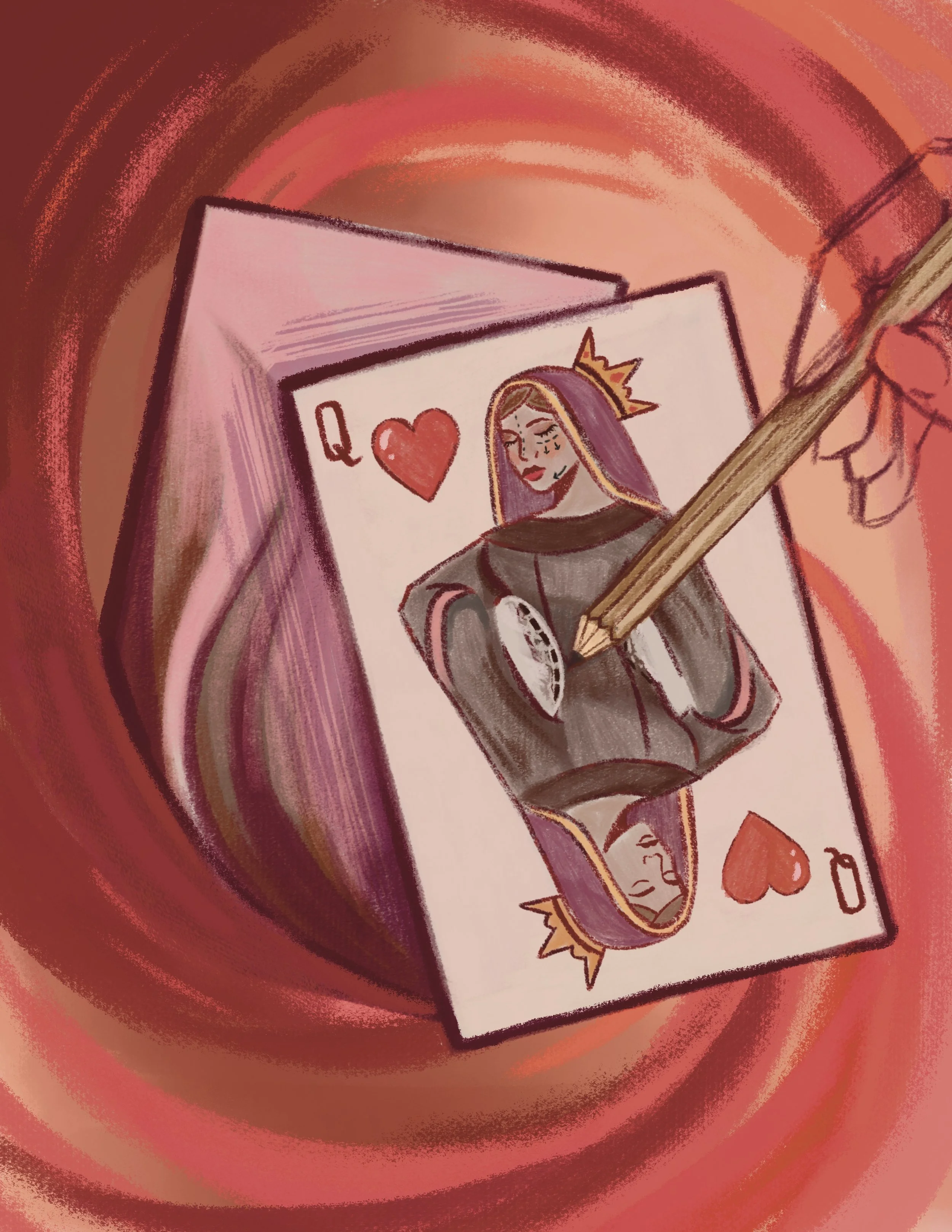
Illustration by Baran Forootan
Throughout history, women have been trained to exist as neither the creators of art nor its target audience. Women–stripped of the role of both the artist and the consumer–have instead been bred to portray themselves in the context of being consumed. They have been given the social position of the object to be admired, while men exist as the admirers. The “male gaze” is a deep-seated cultural language that ultimately renders the mere expression of femininity a performative act. If masculinity prevails as the flesh of humanity, then femininity must be the alteration of that flesh.
Visual art, a historically male-dominated profession, has controlled both the way women are viewed and the way they view themselves. When we stare long enough into the eyes of a woman immortalized on the surface of a canvas, we begin to perceive an illusion of agency. At some point, she begins to appear as if she is aware of her objectification. Her eyes reach seductively beyond the canvas, her gaze yearning for validation. She may at times even be portrayed staring into a mirror with a demeanour of self- admiration. However, when observing these pieces, it is important to remember one thing: we are staring into the eyes of women through the eyes of men. She is not lucid. This display of vanity is still a manifestation of the gaze of the spectator. The woman, a seemingly willing partaker in her own objectification, has unwillingly absolved the artist of their moral responsibilities. In doing so, she has been imprisoned. She is eternally caged in a state of performance, her individuality sacrificed to suppress her to a certain archetype.
The ways in which women have been sedimented in history through the gaze of the male observer never crossed my mind until a recent conversation I had with my friends about the illusive portrayal of Henry VIII’s six wives. These women–commonly remembered through the infamous rhyme of their tragic ends: divorced, beheaded, died; divorced, beheaded, survived–can only be seen physically through a series of oil paintings conducted by Hans Holbein the Younger, the official court painter under Henry VIII’s command. In one notable painting of Anne of Cleves, the fourth wife of Henry VIII, it was revealed through infrared reflectography and X-ray imaging that, throughout layers of paint, her facial expression had been slowly manipulated as the piece was developed. Her initial morose expression had been changed, lips redrawn to uplift at the corners, and her eyes crinkling to yield the illusion of a smile. Her skin was smoothed and softened to remove any and all imperfections. These alterations were likely completed to appeal to Henry VIII’s demand, giving her a more “pleasing” demeanour and framing her appropriately as an object of his desire. The painting is no more than a trophy to Henry VIII, encapsulating simultaneously both the viewer's power and the women’s subjugation.
“The gaze” is not solely how women see the world; rather, it is also how the world looks back at them. As consumable objects, women have been taught to recognize behavioural patterns in how they can draw attention. In a sense, “the gaze” becomes internalized. It curls up under one’s skin and becomes a psychological spectator–a voice commanding not only how to be consumed, but how to change oneself in order to appeal to the consumer. Art, throughout history, has breathed the gaze into an existence as a cultural language. In the cultural dynamic the male gaze establishes, the man wields an inexplicable amount of power. Men learn from the woman portrayed on the canvas. They consume her, and begin to consequently view women through the illusion of her submission. An echo chamber is created through the illusory representation of the female form that has, for centuries, influenced society both consciously and unconsciously.
Women learn to compare themselves against the girl on the canvas; they twist their bodies to mirror those created by brushstrokes that never came from a place of reality to start. As a result of the internalization of this manipulated historical portrayal of women, a woman's identity is often cleaved into two halves: the surveyor and the surveyed. It is an internal division that causes one to perceive herself as merely an external object. The woman’s autonomy is stripped; her actions are not fully her own, but instead those that will allow her to fulfill her role dictated by a certain desire. She learns to wax and wane in all the right places, training herself to become one with the system that breeds subordination, because this is what history has taught her is beautiful. This is what history has deemed art.