Make Sports Gay Again
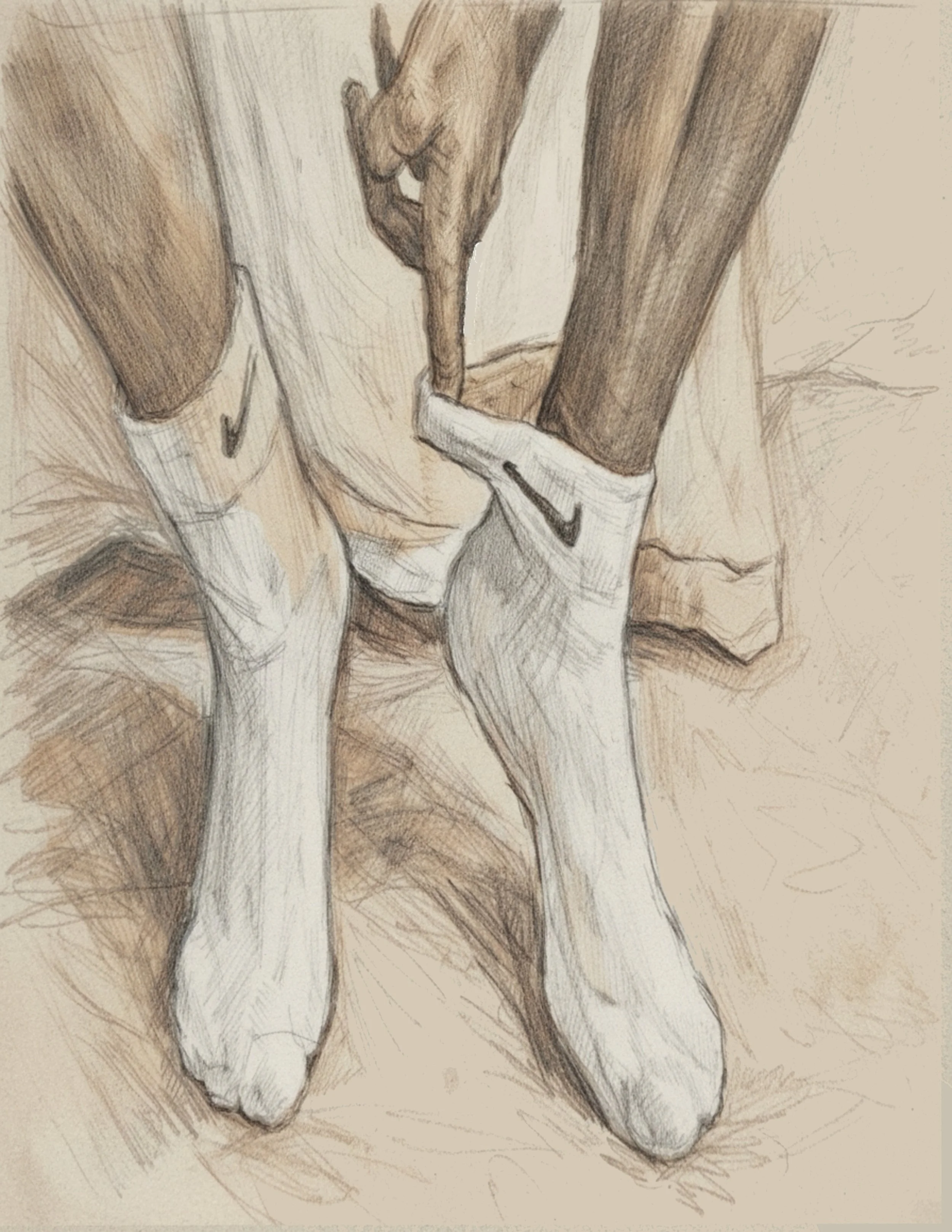
Illustrated by Anthony Liang.
Sports-centred film and television is not a new concept. The idea of the sports film goes all the way back to 1915 with Charlie Chaplin’s The Champion, to Rocky in 1977, and The Iron Claw in 2023. Now two major pieces of media, Luca Guadagnino’s Challengers and Jacob Tierney’s adaptation of Heated Rivalry, have both taken over the world by storm. As someone who is an avid fan of Challengers and Heated Rivalry, and who also used to play hockey and tennis (now more recreationally), I thought I’d give my fair shot at discussing the not-so-obvious places these two interact.
SEXUALITY AND SPORTS
The repression of sexuality is found throughout Challengers and Heated Rivalry, and is reflected in both the relationships between the protagonists, as well as how well they play their game. The primary tension in Challengers comes from Patrick and Art no longer being at the top of their games. Patrick is broke and wants to be good enough to be ranked, and Art is trying to get over his losing streak at the US Open, the only Grand Slam he hasn’t won yet. The two meet at the New Rochelle Challenger, the first time in years they’ve spoken. The last time the two were on good terms was before Tashi Duncan, tennis extraordinaire and love interest, was injured, and the two would rally together. The last time they were on great terms was when they were playing together as Fire and Ice. Tashi explains tennis best as a “relationship,” “like being in love.” The connection Art and Patrick have is represented through their tennis. Only at that final match point, when there are no secrets to hide (see the serving position Patrick assumes to tell Art he slept with Tashi), are they allowed to let go of the anger and resentment, and play some real tennis.
In Heated Rivalry, Shane struggles to break out early in his career. He doesn’t lead Team Canada to victory in the International Prospects Cup and is drafted second overall to Ilya at the MLH draft. All of this occurs after a minor interaction with Ilya in a parking lot when the two are 17 years old. Shane’s suppressed attraction to Ilya, and his subsequent queerness, make him a more distracted hockey player. Only when he begins to embrace his relationship with Ilya, and explore that part of his sexuality is he able to be a better hockey player. He’s finally able to win a (Stanley?) Cup for the Metros, all while engaging in the most direct relationship with Ilya thus far. He performs better as a person and as a player when he has less to hide. When he feels the need to repress, like the lunch conversation with his parents, he masks more and hides from his true self.
While Ilya is comfortable with his sexuality, his attraction and love for Shane is something he pushes aside throughout the series. He doesn’t want to admit he cares for Shane on a level more than sexually, and is terrified about what that means for him and his life. He lashes out at his teammates and himself when Shane starts dating Rose Landry. He shuts out Shane during the Sochi Olympics, for fear of what that means for his Russian identity and nationality if he’s seen with a man he might actually care about. His complications with his sexuality are driven not by an internal war necessarily, but by the societal pressure he faces from Russia, as well as the familiar obligations he has that keep him tied to his home country, even if he hates it. The iconic phone call scene is the amalgamation of that repressed self through his acceptance of himself first, before he can let Shane in. The monologue has to be in Russian, because Ilya deserves to accept and love himself before he can do that for Shane.
TASHI DUNCAN AND SHANE HOLLANDER
It'd certainly be easy to compare Shane and Ilya to Art and Patrick, the shy and arrogant duo known as Fire and Ice. However, I think it is much more interesting and complex to compare Tashi to Shane, as their struggles reflect each other much more as people of colour in white-dominated sports.
When Tashi is introduced in Challengers, Art tells Patrick she’s going to make her family millions—she’s already got Adidas sponsorships; who knows how her fame will skyrocket after she has a few Grand Slam wins under her belt. But Tashi isn’t just a tennis player. She’s also the only Black tennis player we see in the film, the only one of the main three who doesn’t have the money to go off and play pro when she turns 18. Tashi knows she has the pressure to be a role model and a breadwinner for her family, even if she doesn’t outwardly state it.
In episode one of Heated Rivalry, Shane is drafted to the Metros, and the GM immediately talks about how open they are to his heritage, to which his mother Yuna steps in to talk about the role hockey played in making her feel more Canadian. Later, Yuna talks to Shane about a brand deal with Reebok that he dismisses, before she reminds him about how many young Asian-Canadian kids will be looking up to Shane. Shane reacts to it like a teenager being pestered by his mom, but as a kid prodigy and hopeful generational talent, it’s clear Shane has carried this knowledge with him for years.
Sports like hockey and tennis have accessibility issues that not a lot of racialized kids can access. In Canada, soccer has easily beaten hockey in terms of popularity, as it can cost over $1500 a year on equipment alone. While tennis has been dominated by the Venus sisters and now young talent like Coco Gauff, the level of disrespect they face from competitors, media, and fans of the sport all takes an immense toll on one’s mental health. Tashi and Shane are both generational talents. They're dedicated and driven to win, no matter the cost. Hockey and tennis are all that either of them has ever known, and they intend to be the best at it. But the hardships and expectations for themselves as racialized athletes are what separate them from the rest.
SHOOTING SPORTS
I can’t discuss two mediums so driven by visuals without talking about the way cinematography is used in the show to show sports. Although it is limited in Heated Rivalry compared to Challengers, both do a great job at keeping up phenomenologically, to keep the audience actively engaged in the tempo that a real game or match would be. Heated Rivalry utilizes the intercutting of slow-motion scenes to emphasize or heighten reality. The All-Star game, where Shane and Ilya pass to each other, highlights how in tune they are with their relationship after years of getting to know each other. It's like only the two of them exist on the ice. DP Jackson Parrell makes incredible use of the harsh fluorescent lights in the arena to make each hockey scene feel like a different game in a different arena. The game of hockey is viewed as if you're watching the game live in an arena; each moment of adrenaline and rush is captured as if you’re a fan.
Challengers takes an opposite approach by literally putting the viewer inside the game. Sayombhu Mukdeeprom, the Thai cinematographer behind many of Luca Guadagnino’s films, really utilizes fast-paced action to capture the final match between Art and Patrick. Although the film starts with using more POV shots from the crowd’s perspective, the film's climax feels as intense as playing a game of tennis. The drone/CGI hybrid shots move back and forth as the ball does, before moving to get a full 360-degree scope of the court itself. You can feel the sweat dripping off Art, and the sun blazing down on Patrick. The closeness of the cinematography means you feel the highs and lows of the moment, like the characters themselves.