
Illustration by Christina Wang
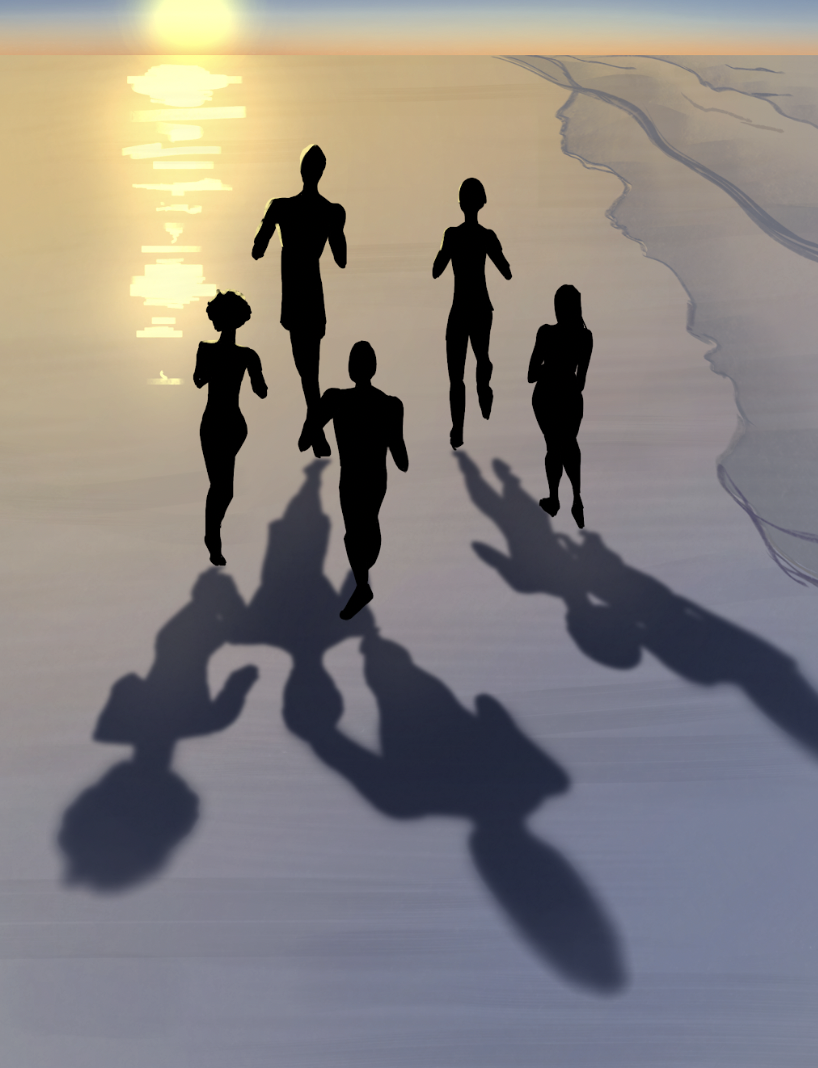
I've been watching it happen for a while now — the slow, then sudden, reappearance of the run club. First it was a few people I followed on Instagram, their Strava screenshots bleeding into my feed. Then it was colleagues, eventually my neighbour, who once organized a group run to the pier for all our friends to “train” for a 5k run . By last summer I was noticing packs of them every evening, moving through streets that used to belong exclusively to dog walkers and delivery drivers. Something, clearly, was going on.
And it wasn't just running. Supper clubs started showing up in my inbox. Book clubs that weren't your parents' book clubs. Hiking groups. Saturday morning swim crews. A friend joined something she described as a "foraging walk" with total sincerity. The activity almost didn't matter. The point, increasingly, was the gathering itself.
So what's actually going on here?
I think the honest answer is that this isn't a fitness trend. It's a structural one. For a long time, our social lives have been built on two unstable models: spontaneity, which rarely happens authentically, and performance, which happens constantly. You either say, "let's grab drinks sometime," and never do, or you curate yourself into a version that can withstand being watched. What's been missing is something in between. A framework that makes connection feel both intentional and low-pressure.
Clubs, it turns out, are that framework. They offer what I can only call pre-planned intimacy: a reason to be there, a built-in activity, just enough distraction to make connection feel accidental instead of engineered. You don't have to be interesting right away. You just have to show up, run a few kilometres, pass the bread, comment on the book. The relationship builds in the margins.
Think about what modernity quietly dismantled. The pub. The church. The neighbourhood. All those unglamorous, durable third places where you showed up regularly, saw the same people week after week, and slowly without agenda or branding became known to each other. We didn't notice they were gone until we were very lonely. A 2024 Harvard study found that 21% of Americans are living with serious loneliness, with nearly three quarters saying technology is part of the reason. We built the internet to connect us and ended up more isolated than we'd been in generations.
The run club, and all its cousins, are people rebuilding that infrastructure by hand. The repeated showing-up is what does the work. The same faces on Wednesday evening. The post-run coffee that runs longer than the actual run did. We've spent a decade optimizing for frictionless interaction; messaging instead of calling, liking instead of speaking, consuming instead of participating. And what we're realizing, slowly, is that friction wasn't the problem. It was the point. Clubs reintroduce just enough of it to make connection feel earned again.
I realized how far this logic had gone last summer, in San Francisco. We were on a girls' trip, standing on a sidewalk watching a run club pass: one of those large, slightly intimidating groups that move like they already belong to each other. And offhandedly, one of my friends mentioned that her cousin had met their partner at a run club. Then another chimed in: she knew people who'd joined specifically to date.
It made immediate sense. With more than half a million Tinder users abandoning the platform since 2023, run clubs have quietly emerged as one of the most popular alternatives for singles, not despite being about running, but because of it. What the run club offers that Hinge structurally cannot is information gathered through the body. You see how someone moves through difficulty. Whether they encourage the slower person behind them or surge ahead. Whether they're easy in their own skin when they're tired and slightly out of breath. In Boston, the singles-oriented Lunge Run Club started with around 30 people in May 2024 and swelled to nearly 1,000 runners per week by summer's end with singles wearing black shirts so everyone knew. Three miles tells you more than three weeks of texting, and everybody knows it.
Researchers tracking the shift note a renewed cultural appetite for what one academic described as "the social and material infrastructure for an embodied way of dating" which is a very elegant way of saying: people want to meet each other in their actual bodies again, doing something real, without the weight of immediate evaluation. No profile, no opening line, no pressure to perform within the first thirty seconds. You exist alongside someone first. Attraction, if it happens, has somewhere softer to land.
Running, therefore, solves a very specific modern problem in this regard: how to be with people without the exhausting intensity of direct social performance. You don't have to maintain eye contact or fill every silence. Your body is occupied, your attention shared, and conversation becomes optional rather than required. It's socializing with an exit valve.
Supper clubs operate on the same logic, just inverted. Less movement, more stillness but the same scaffolding. You're not just "hanging out." You're attending something. The structure does the heavy lifting so you don't have to.
For a growing segment of participants, particularly younger urban runners, running now functions as much as a social identity as it does exercise. Strava's own data found that Gen Z is 39% more likely than Gen X to use fitness specifically to meet people who share their interests. This generation didn't stop wanting connection. They stopped trusting the platforms built to deliver it, and started constructing their own systems instead.
The fact that we need to engineer the conditions for the kind of accidental human contact that used to just happen, at the corner shop, at the local pub, or the farmer’s market says something about what we lost without noticing. The run club is beautiful, and it is also a workaround. A smart, joyful, increasingly romantic workaround, but still.
Last summer was the proof of concept. Warm evenings, longer days, a collective willingness to try. But what it revealed wasn't just seasonal enthusiasm, it exposed a structural gap in how we socialize. And once you notice that gap, it's hard to unsee.
So yes, the run clubs will be back this summer. Probably in greater numbers. But more than that, I think we'll see the format expand; more niche, more specific, more intentional. Not just clubs, but carefully designed ways of meeting people. As friends, as strangers, and sometimes, quietly, as something more.
We're not just looking for things to do. We're looking for ways to be around each other that don't feel like work.