Life Tracking: An Under Appreciated Art
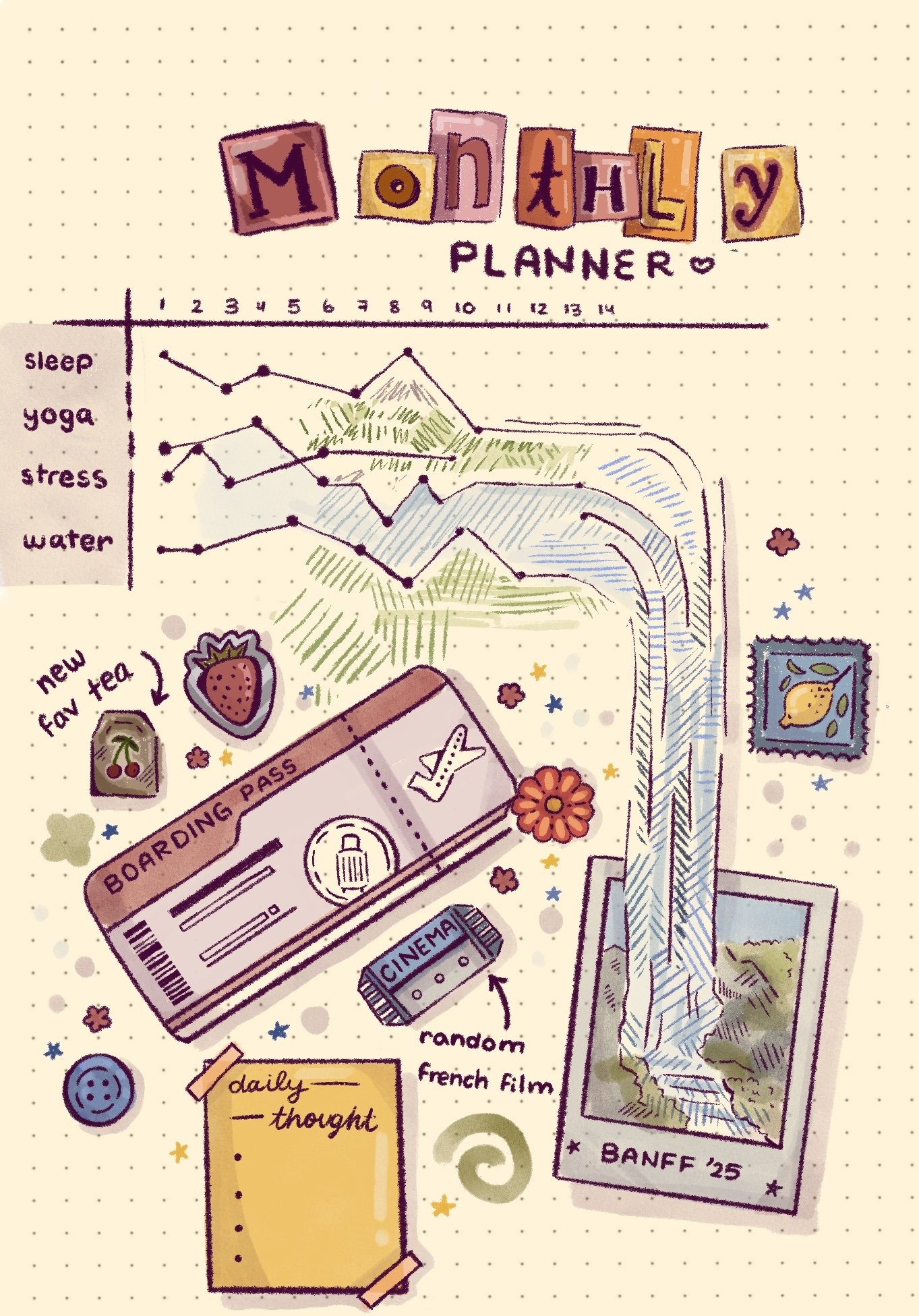
Illustration by Baran Forootan
Life-tracking is quite a loose term for any sort of record of daily life. A diary could be life-tracking,but so could keeping a log of Strava running records, so could a detailed, hourly
spreadsheet that accounts for the activities you do in a day. Ostensibly, this is quite redundant –
Why would one decide to reaccount the day they have already lived?
However, I believe the redundancy to be the point. Oftentimes, it is addicting to keep looking forward, to keep pursuing the future without looking in the rearview mirror. While it is certainly not a bad idea to be future-focused, and to plan in the long-term, what is the point of reaching higher and higher if we never stop to appreciate the heights we’ve conquered in our journey? I think back to being a kid, and whenever my parents would ask how my day was, or what I did in school that day, and I would lazily respond with a “nothing”, not out of laziness or apathy – those days would often be filled to the brim with sharable moments – but out of a contempt for the past, a feeling that what has passed is no longer worth recounting in the present. Due to this contempt, there’s so much I have forgotten about the past, with fleeting remnants of those memories floating to the top of my mind when I see a souvenir from a fifth grade class whose teacher’s name I no longer remember. Lifetracking, to me, is an attempt to transport these memories to writing, so that I at least have a framework to help me remember the lessons I learn from the challenges of daily life.
To give perspective into how a lifetracking scheme could look, let’s look at the three primary methods I use:
The first is quite simple, a spreadsheet where I track my mood on a scale of one to ten at three points in the day: just after waking up, just after eating lunch (a reasonable expectation for when I’ll be at peak busyness during the day), and before putting my phone to bed for the day. The overall philosophy behind this one project is to track how I feel, and overall observe any patterns I can find. There’s no greater joy than creating a line graph every couple of months and seeing the peaks and valleys, because that’s when you truly begin to appreciate either the difficulties you’ve managed to overcome or the numerous blessings you’ve had to experience the highs you’ve had. It can also be quite amusing to see just how much variety there can be in your life. Obviously, this is not meant to be some formal diagnostic tool, or some professional, rigorously tested mechanism for evaluating happiness, but rather just a fun way to see how life is going from a birds-eye view.
The second one is also pretty simple: it’s just a list of the meals I have during a day. This is the least profoundly metacognitive of the life-tracking setups I use, but it serves as a good example of life-tracking’s ability to be as complex or as simple as you see fit. This was mainly a way for me to make sure I was diversifying my meals in university. When you’re busy, or stressed, or both, it can be quite easy to lose balance in meals, and end up eating certain foods too often. This way, I manage to ensure I’m still keeping variety without having to ask “when was the last time I made this?” every time I enter the kitchen. A similar set-up could work for clothes, walking/running routes, or any other quotidian activity that has room for variety.
The third one is the most complex of my set-ups and is a reflective schedule of my days. I grouped all of my daily activities into large categories, like watching TV, studying, spending time with family, eating, sleeping, and many others, and colour-coded each (if you end up trying this,please make a legend to remember your colour codes!). Then, I made a spreadsheet with a cell designated for each 30 minute slot of each day. Before I sleep each night, I fill in the sheet to the best of my abilities, and add notes in cells where something unique – like going to the dentist, or voting in an election – happens that I want to easily remember by looking at the sheet. Without a doubt, the most interesting analysis of this is the arcs of sleep and wake times. It is quite hilarious how my sleep time appears to creep later and later before hard-resetting back to factory settings, which is perfectly reflected by sharp, triangular, purple oscillations in the schedules (purple is used to represent sleep in my model). This could be quite cumbersome to fill in every night, so some work arounds could be to do 1 hour time periods or to choose larger categories. For instance, a potential version of this could be to have only three groups: work/education, family, self.
Lifetracking is a way to create little time capsules for yourself every day, and then eventually, these memories will compile themselves into visual, written, or even auditory reflections of You, including the You that you were and the You that you’ve become. Every day is either slightly different to the last or an entirely new adventure altogether, and I’ve found that lifetracking has helped me appreciate that more. While this may have a different effect on you, or perhaps you’ll find it a burden, a chore, more than an art, I still hope you try it. It’s your picture to paint; no one can grade you on how well you do it and no one else even needs to know, unless you want them to!