
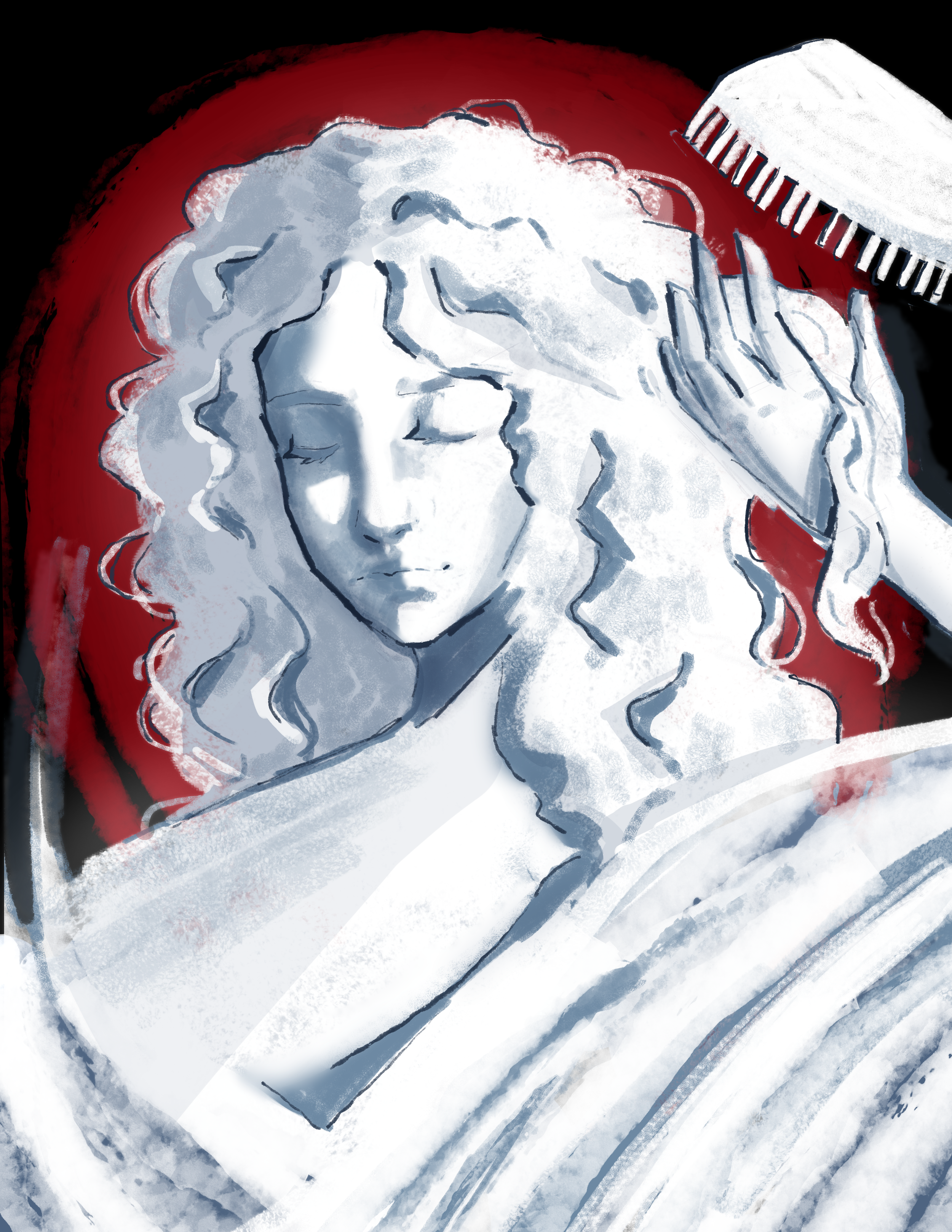
Illustration by Meghan Zhang
There was a time when I could look at my body and feel at home in it, but when I turned twenty, Lupus changed everything. I became unrecognizable to myself as it wrecked havoc on all that was once strong, familiar, and predictable. With every flare-up, the pen strokes of chronic illness wrote stories across my body that I didn’t ask to live. My reflection shifted, and so did the way I saw myself and the way I felt seen.
I used to know what it felt like to be desired but Lupus told me I was less than as my body transformed. Rough scars etched themselves across my skin after each procedure, aching joints kept me awake at night, and as my hair thinned and fell in clumps, my self-esteem became a fragile thing balanced precariously on a foundation of what once was. Some mornings, I would avoid mirrors altogether. It was easier than seeing the shadow of someone I used to be.
The stranger in the mirror was exhausted. She lived in survival mode: counting pills, pushing through classes, going to doctor’s appointments that she wouldn’t be able to emotionally process until weeks or even months later. There wasn’t any time or space to just be, let alone feel beautiful. Rituals that used to make me feel good; doing my hair, putting on mascara, choosing an outfit that made me feel confident, fell away. My reality was stripped raw. And yet, there was a growing ache for the girl I once was. I’d catch a glimpse of her in an old picture, laughing with her arms outstretched, and feel my throat close up. I grieved the loss of her like she was dead.
But I wasn’t grieving alone. My partner had been there before the scars and the fatigue. And yet, every time they looked at me, I wondered what they saw. Did they notice the scars that don’t fade? The stiffness in my joints when I moved? Did they miss the“old me” as much as I did?
In these moments, intimacy often felt like an impossible ask. How could anyone desire what I struggled to embrace? But then, on a random Tuesday, they would catch me off guard and say “You’re beautiful, Alexia” with such conviction that it would make me pause, mid thought. They didn’t see the imperfections I obsessed over.
I began to see that sexy isn’t a static image but a living breathing act of connection. It’s not the perfect outfit, winning smile, or flawless skin I used to chase. I began to find it in the raw vulnerability of choosing to be seen fully and unapologetically. I found it in the moments of resilience: when scars were no longer signs of imperfection, but badges of battles fought and survived.
And desire? It isn’t born from the absence of flaws– it’s born from presence. It’s in the way my partner brushes my hair on the days I can’t lift my arms. It's in the trust built in navigating the unspoken: when I say, “Not tonight,” and they understand that it’s not a rejection, but a threshold I have to honour. Sexy is the act of learning new rhythms of desire to fit into bodies that move slower but love just as fiercely. It’s in the laughter shared on days when chronic illness tries to steal joy but fails. It's finding tender mercies in life’s unexpected moments.
Redefining sexy has become an act of rebellion. A rejection of society’s obsession with perfection, hypersexuality, and performance, insisting instead that imperfections and softer forms of desire are just as worthy.
This rebellion is liberating: I’ve stopped waiting to become who I was and started to honour who I am now. And I’ve realized that not all of me has been lost. I’m still the girl who runs because it makes her feel free, who reads until she falls asleep with the book lying on her chest, and who loves wine nights with friends. Except now, I’m also the girl who sometimes limps the morning after a run, who reads lab results as intensely as novels, and who has to think twice before every drink. And this doesn’t make me any less worthy of being wanted—by others or by myself.
I used to think sexy meant liking what I saw, but that version of sexy was fragile. Easy to lose. Some days I struggle to forgive my body for the ways that it has changed, and to see it as worthy of love when it feels like it’s working against me. On those days, my partner becomes the mirror I can trust, reflecting more than the surface. Its love is patient, gentle, unflinching. It holds space when I feel broken, and reminds me that I’m still whole.
And in the quiet moments, when their fingers trace over my skin, I feel something I thought I’d lost: sexy–not despite my body, but because of it. Because it’s mine. And that makes it worthy.
The mirror doesn’t haunt me like it used to. Some days, it even feels like home.