
The Band Tee Problem
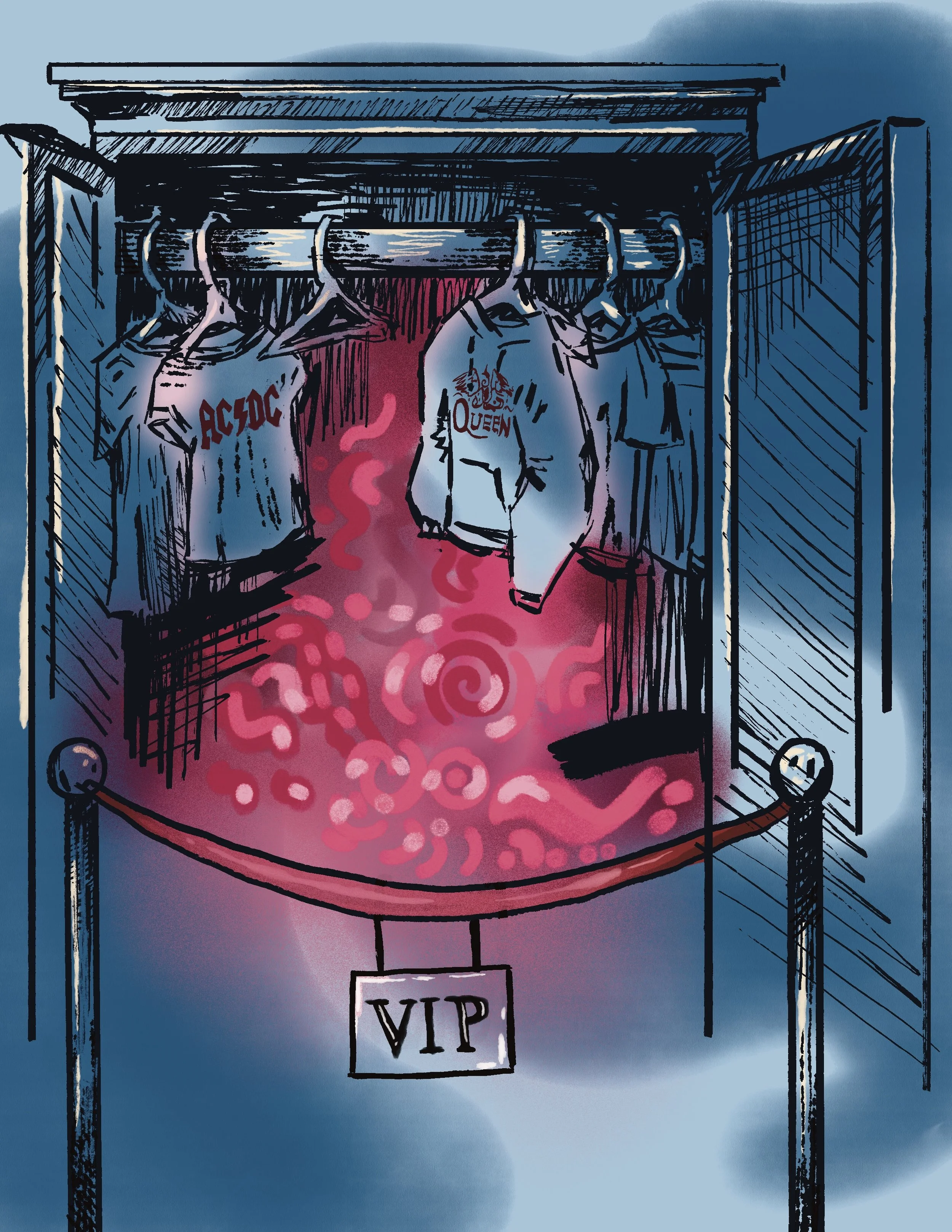
Illustration by Baran Forootan.
Cool shirt. Name five songs…
A request that has launched thousands of eye rolls from music fans across the board; a gatekeeping ritual which makes, even the most loyal fans, doubt themselves, and their musical prowess. Whether you find yourself backed in a corner for wearing a Slipknot shirt in attempts to shake-up your usual cardigan rotation, or making the grave mistake of claiming “Creep” to be your favourite Radiohead song… so many people wind up in a sudden pop quiz for simply not fitting the mold of what we would “expect” them to listen to. Expressing a clear interest in an artist that “doesn’t fit your vibe” opens the floor for a verbal TSA check, performed by a self-appointed guardian of the genre – usually found hovering near the Pink Floyd section in your local record store, waiting to catch you in a lie.
The band tee has proven itself to be a fascinating phenomenon over the decades, evolving from a uniform of counter-cultural fandom into a universal wardrobe staple. The rapid trend of band merchandising was pioneered in the early 1960s, along with the unprecedented explosion of Beatlemania. Although expansive fandoms were common prior to this, such as the Elvis Presley fan clubs of the 1950s, The Beatles were truly the first to embrace the large-scale band merchandising model, thanks to their manager Brian Epstein. However, the "Golden Age” of band tees did not gain its footing until the 1970s, with the trend only growing bigger well into the 1990s. It started in 1976, when Arturo Vega designed the iconic Ramones’ Presidential Seal. Although it was clearly intended to promote the band’s music, it boomed in popularity, with the Ramones eventually selling more shirts than records. Even if someone wasn’t familiar with the musical stylings of Joey, Dee Dee, Johnny, and Tommy, they, without a doubt, would recognize the shirt. And by the time the ‘90s arrived, the grunge movement solidified the band tee as a symbol of anti-establishment grit. It was messy, it was thrifted, and it was inherently political.
In this era predating the algorithmic playlist, the musical logo plastered across one’s chest was a billboard of identity; it was a way to find your people in a crowd – a visual handshake which read “I was there. I belong. I believe what they believe.”
Fast-forward to 2026, and the landscape continues to shift into a high-contrast mosaic, where we find a multitude of origin-stories behind people's band tees…
Number One: “The Artifact” – A faded hand-me-down from a parent’s concert-going days – usually passed off with the infuriating reveal that your dad only had to pay a few bucks to see Aerosmith when he was your age.
Number Two: “The Found Object” – A $5 vintage gem unearthed on a thrift store rack.
Number Three: “The Irony” – A bright pink Nirvana sweatshirt—a product of late-stage capitalism that would likely make Kurt Cobain’s head spin, yet sits prominently on a shelf at Hot Topic.
The reasons for wearing a band shirt are as diverse as the genres themselves, and deeply personal to the individual. Perhaps it’s a representation of your, or a loved one’s favourite band. Perhaps it’s a piece of concert merch acting as a conservation of a great night. Perhaps it’s a gift from a relative who saw a skull on a shirt and assumed you’d like it even though you’ve never cared for Blink-182 and yet, you wear the shirt anyway. And perhaps it’s a cool design, and the wearer just likes the way the typography interacts with their jacket – maybe they’ll give the artist a listen one day, maybe they won't.
In some corners of the music scene, wearing a band tee is less of a fashion choice, and more of a walk into a high-stakes examination. Apparently, if you don’t know Kirk Hammett’s birth weight or the name of every B-side from a 1984 album, you’re committing stolen valor, you’re a poser… and it's a weirdly defensive hill to die on. You’d think if someone truly loved a band, they’d be stoked to see their logo out in the wild. But instead, we’ve turned the humble cotton tee into a rigid entrance test where you have to recite the entire discography just to earn the right to wear the merch.
The irony? Band tees were quite literally designed to be conversation starters. They are the ultimate "I like this thing too!" icebreaker. But these days, the only conversation we seem to be having is a frantic interrogation.
This probing, in attempts to weave out the “fake fans,” also tends to have a stark gender divide. Being a young woman, myself, with an affinity for ‘70s rock and ‘90s nu metal, I often find eyes locked in on my Black Sabbath shirt faster than my male counterparts. Could I, undoubtedly, answer niche trivia about the group? Absolutely… but this is beside the point. Even if you follow the "only wear what you know" code, it doesn't matter if people have already decided you don't look like a “real fan.” We live in a world where everyone claims to listen to "a little bit of everything," yet some remain dumbfounded if they see a System of a Down fan also vibing to Conan Gray, or the Phantom of the Opera soundtrack. Although this can be argued to be a protection of a community, how unified can we truly be if we are assuming someone can, or cannot, “name five songs” based on their presentation?
To be quite frank, I could not care less about how others choose to dress themselves. If you want to wear a Megadeath shirt because you think the font is gnarly, while you proudly listen to synth-pop or Frank Sinatra, that is truly your prerogative, and no one else’s business. The real "Band Tee Problem" isn't the person wearing the shirt; it’s the weight we’ve attached to it. We’ve turned a medium of connection into a litmus test for belonging. Music is, and always will be, for everyone. I don’t believe it should matter how someone discovers an artist, so long as we can all enjoy their music, and be respectful of others. Even if there are people wearing a shirt featuring a band they aren’t a fan of… who are they hurting? After all, if the goal is to promote conversation and community, "hey, that is a cool shirt" is a much better opener than a pop quiz.