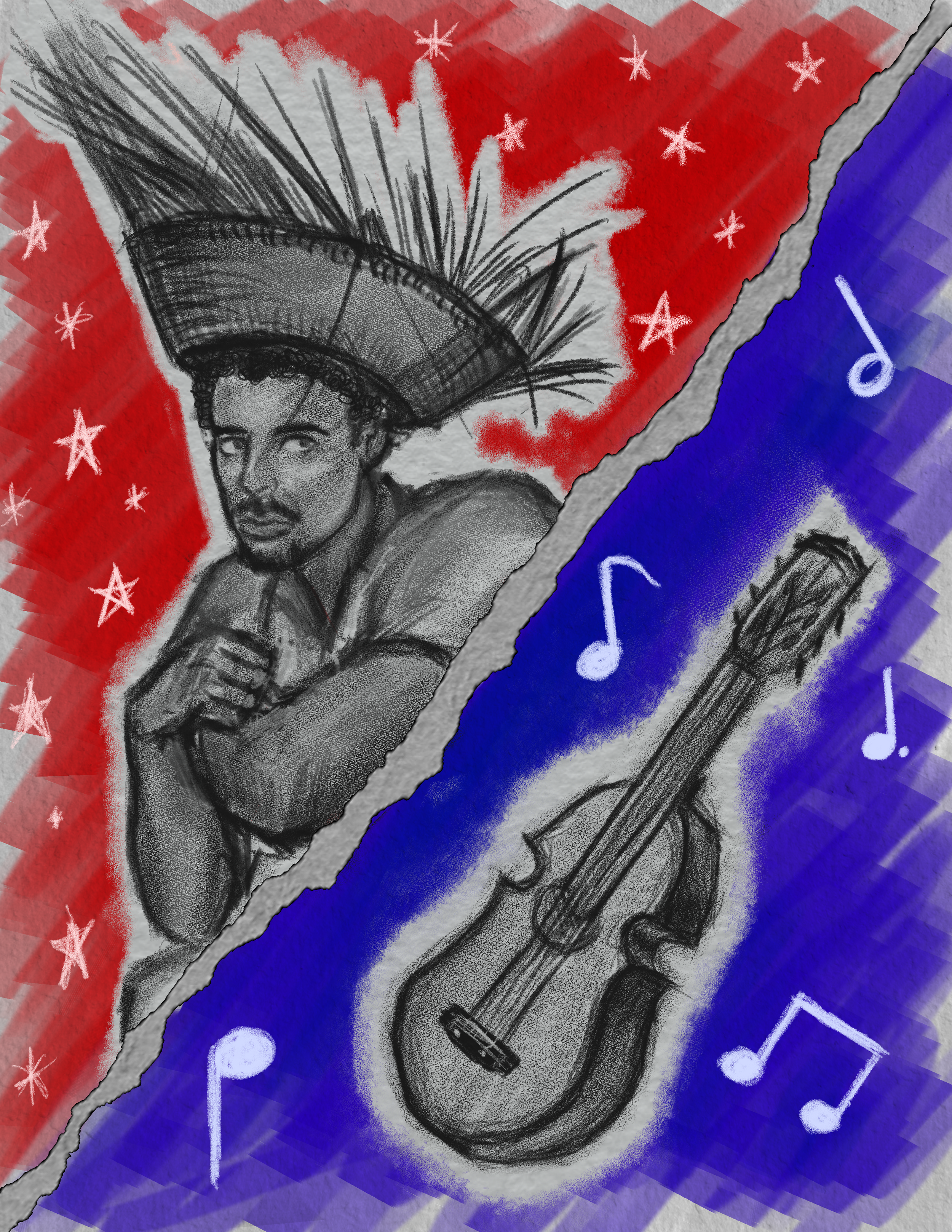
Illustration by Iman Jafrani.
I would argue that the highlight of any Super Bowl game is the halftime show. The Super Bowl halftime show was originally an afterthought compared to the game itself. However, Michael Jackson’s iconic 1993 performance completely transformed people’s perceptions and popularized the halftime show on a global scale, making it the annual spectacle it is today. From Prince to Madonna and Beyonce, the Super Bowl halftime show is now a stage for musical greats to showcase their talents and create historical pop culture moments. Announced on September 28, 2025, Bad Bunny was named the performer for the Super Bowl LX halftime show. Bad Bunny is a Puerto Rican rapper and singer, known for his Latin trap and reggaeton music. He is one of the biggest artists in the world right now, totalling almost 118 million monthly Spotify listeners and most recently receiving three new Grammy wins, including Album of the Year for his record-breaking album Debí Tirar Más Fotos, at the 2026 Grammy Awards.
Bad Bunny’s halftime performance this year was filled with dance, colour, joy, and even a salsa rendition of the popular song Die With A Smile by hit artist Lady Gaga. However, one of the most intriguing moments during his halftime show was his performance of the 2022 song, El Apagon, as he stood on fiery, broken power grids. El Apagon translates to The Blackout in English, and speaks to the persistent power crisis that Bad Bunny’s home of Puerto Rico endures due to unreliable power grids provided by private electrical companies and climate-crisis driven extreme weather events (Why Was Bad Bunny Singing on Top of a Broken Utility Pole at the Super Bowl? - Earthjustice). With this being one of numerous instances of social justice messaging throughout this year’s halftime show, the performance led me to reflect on the greater societal influence that music can possess.
One can look back to as early as the 19th century, when the Indian Act enforced the banning of traditional Indigenous music across Canada, with those who broke this federal law sentenced to jail time. Indigenous peoples were forced to perform traditional songs and instruments in hiding from the late 19th century to the mid 20th century, fighting to preserve their musical culture in an act of resistance against colonial measures (https://humanrights.ca/story/heartbeat-people).
The American Civil Rights Movements during the 1950s and 1960s was an especially poignant time when music acted as a form of resistance. We Shall Overcome became an anthem heavily associated with the Civil Rights Movement. The song traces its origins to spirituals sung by enslaved African Americans, as well as to the gospel tradition. However, the song was popularized by famous folk singer Pete Seeger (We Shall Overcome: The Story Behind the Song). The song’s relative simplicity to learn made it extremely effective as a resistance anthem, allowing people to use their voices and unify them against segregation and historic injustices (We Shall Overcome: The Story Behind the Song). Other iconic songs representative of the Civil Rights Movement era include A Change is Gonna Come by Sam Cooke, Mississippi Goddamn by Nina Simone, and Alabama by John Coltrane (Music's Voice in the American Civil Rights Movement).
Coming back to the present day, music still acts as a significant support for resistance movements against inequality and oppression. With its deep history of politically and socially conscious songs, rap music has provided society with a plethora of modern protest anthems (History of Rap & Hip-Hop). The 2015 song Alright by Kendrick Lamar became the anthem for resilience against police brutality and anti-black racism during Black Lives Matter rallies. In 2018, Childish Gambino released This is America, with an equally powerful music video, similarly highlighting the pertinent issues of gun violence, systemic racism, and police brutality in the United States. Recently in 2024, Macklemore released Hind’s Hall in honour of Palestinian six-year-old Hind Rajab, who was killed in Gaza by Israeli forces, and became widely recognized across the Pro-Palestine Movement (Hind’s Hall is Macklemore’s bold new pro-Palestine anthem. What might it actually achieve?).
When considering the long history of music utilized as a form of resistance, it is clear that few things can unite people for a cause like music does. The combination of deeply thoughtful lyrics and the moving tone of an artist’s voice can sometimes help convey feelings and messages better than solely words can. My personal belief is that there is something innately human about music, and that when we hear the right song, it pierces straight through to our soul and reminds us of our humanity. To the part of us that recognizes that we are not here on Earth alone, and want to use our goodness to help others. That life is not just living for ourselves, as that would be quite lonely, but rather leaving the world a little bit better than when we arrived.
Bad Bunny ended his Superbowl Halftime Performance with the message “THE ONLY THING MORE POWERFUL THAN HATE IS LOVE,” plastered across a huge TV screen in Levi’s Stadium. It is a reminder to us all, maybe in a more important time than ever, to show love to those we care about, stand up for what we think is right, and speak up for those who can’t. And if you ever feel like you can’t find the right words to say what’s on your mind, that’s okay, sometimes it’s as easy as finding the right song to do it for you.