
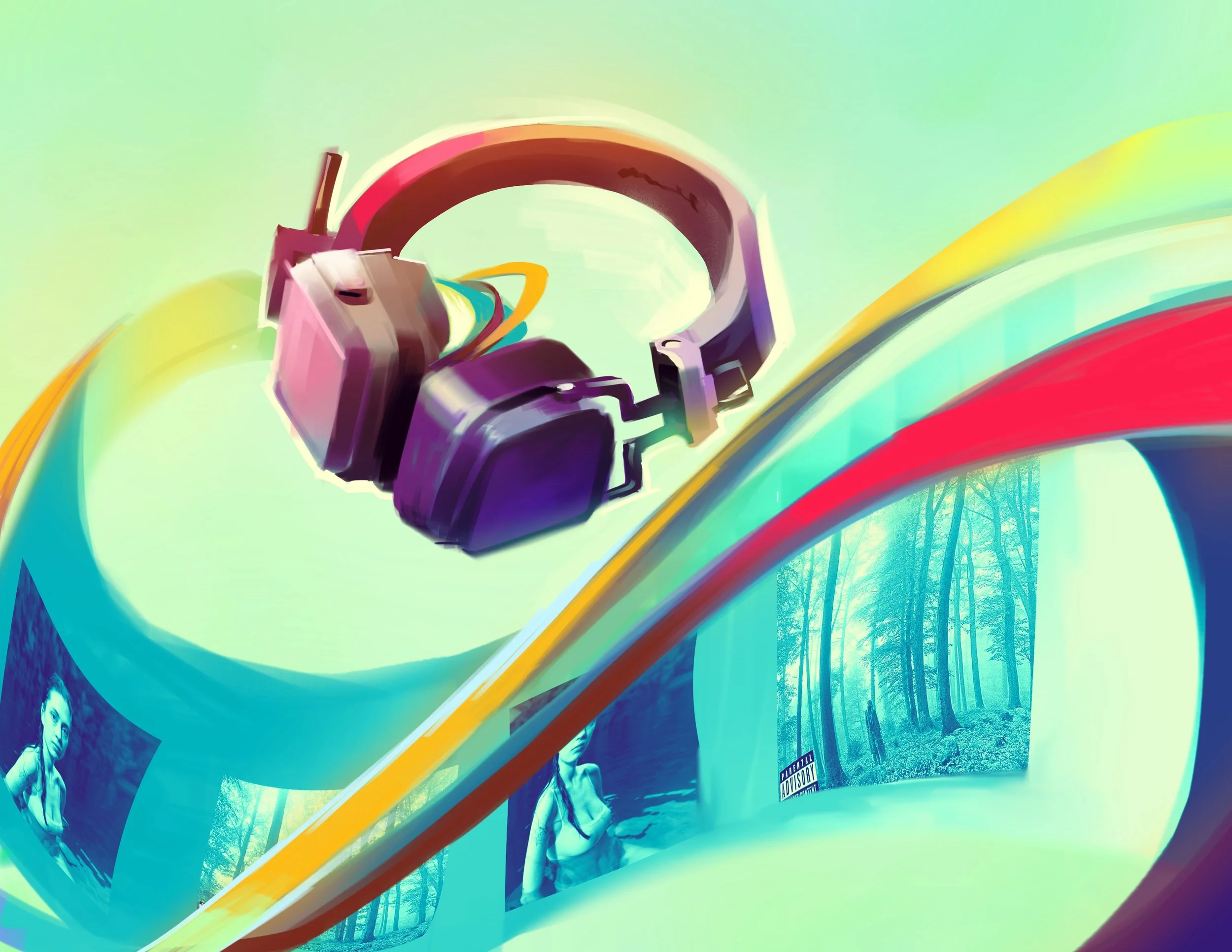
Illustration by Jayda Korn.
Failure has a strange way of ruining an otherwise ordinary day. One bad grade. Two missed alarms. A hundred rejection emails. Suddenly your messy desk, three-day-old coffee, and the grey Kingston weather snowball into a cocktail of “bad” emotions.
Failure can be isolating.
Luckily, like most things in life, good music and a few personal rituals can help with almost every major and minor problem in your life. Here is my musical formula to make sure that my days remain more than alright, curated around the five stages of grief: denial, anger, bargaining, depression, and finally, acceptance.
Denial: “This can’t be happening to me!”
Here’s my hot take: 5 minutes of silence. Sometimes, I just sit there and stew in stunned silence.
I think it’s only fair that I get to listen to whatever music is most comforting. My “I can’t believe this is real” is constantly accompanied by instrumental music. Because sometimes, I just want to listen to sad music that doesn’t have the lyrical potential to ruin my life by actually relating to my own life problems.
Instrumental music comes in as a surprisingly neutral genre. It’s just instruments layered over a beat. Not knowing what to do about the situation is not nice, but sometimes that discomfort is how you grow. Instrumental music makes it easy to enjoy the privilege of not having everything figured out yet.
My favourites are film soundtracks like Challengers, classical songs like Chopin’s nocturnes and waltzes, or as a bonus: the guitar covers of Cigarettes After Sex songs.
Anger: “Crash out incoming.”
Songs like That’s so True by Gracie Abrams, In the End by Linkin Park, or Messy by Lola Young have one thing in common: they are all pop anthems the internet has decided are more appropriate to yell than sing.
These are songs whose lyrics we can relate deeply to, and when accompanied by a catchy melody, I can listen to them until I am literally tired.
Be loud. Rant. Get everything out. Anger is healthy because then you know you’re on the way to healing. Acknowledge that the world feels maybe a little unfair right now.
By the way, the only appropriate way to listen to angry songs are headphones on, limbs warmed up for visceral angsty gestures.
My angry song picks are Brutal by Olivia Rodrigo, Not Strong Enough by Boygenius, Just by Radiohead.
Bargaining: “Well, since it happened…”
Bargaining is the stage of what ifs. It’s replaying the situation in my head while pacing my room, replaying the situation in my head like a movie scene you could somehow edit.
The vibe is thinking music. Life is too short to not listen to music that makes you delusional. You’ve had your denial, and your anger, but the truth is that at some point, you have to start thinking of how you can get past this.
I don’t mean that you need to have the solution right away. In fact, I would take the time to go over every single scenario in my head. I’d go through every single scenario of how it could have gone, because going over what I should have done is another form of improvement for the future.
After that is the fun part: I start thinking of where I should go from here, and all the possible scenarios that can unravel from this one failure. I love songs that get you thinking about life because it’s fun to play around with your imagination, even if it is just a hypothetical rainbow after the rain.
My delusional bargaining songs are It Won’t Always Be Like This by Inhaler, Hush by The Marías, and The Adults Are Talking by The Strokes.
Depression: “I’m getting over it. I just need time.”
That quiet aftermath is the worst. As the gravity of what happened settles down, all I need is this affirmation: Yes, it is okay to be sad. It’s okay to grieve what could have been.
What do you do when it feels like the world is collapsing? I personally enjoy a quiet night in, and listen to whatever music is most sad and comforting. Slow sad validation vibes. Music can definitely help with that.
Sad songs have a slow tempo, quiet and subdued instrumentation, and low-pitched, dragged-out melodies. Some songs are just enough to let you feel that sinking, messy heaviness without judgement. Kind of like a warm blanket.
The magic I feel in this stage is that happy-sad feeling. The feeling where, even in the sadness and disappointment, I’m a little glad I got to do it anyways. Because we’re all still here, still learning, and still listening.
It’s the part of failure where you start accepting that life isn’t perfect, and that’s okay.
My saddest songs are Ceilings by Lizzy McAlpine, Once More To See You by Mitski, Re:Stacks by Bon Iver.
Acceptance: “Well, that just happened. But my world hasn’t ended yet.”
Failure is a part of life. Uncomfortable, messy, embarrassing. Boom. Failure accepted.
But when I think of accepting failure, I don’t just think of accepting that it happened. I make it mandatory for myself to be hopeful about it, too.
As cliche as it sounds, failure can be a way to improve. But it doesn’t have to be a super dramatic improvement, it can just be hope for better next time.
This last stage of failure can be anything you want: sunlight creeping into the room, flowers blooming, or a phoenix rising from the ashes.
My most hopeful songs are Wonderwall by Oasis, Sofia by Clairo, and On My Way by Wallows.
Failure, to me, is a word with bad and scary connotations. We treat it as something to overcome as quickly as possible, when in truth, there is so much value in sitting in that discomfort before moving forward.
What I wanted to ultimately explore is how we can humanize that experience. I think there is so much power we can reclaim by saying,“Hey, there are other ways you can define this day still!” And that would be the ultimate goal for me: to reach a place where trying so hard and failing doesn’t feel unsuccessful.
Maybe just unfinished.