
Crowded Bars and Loud Guitars: Finding Belonging in an Othered Space
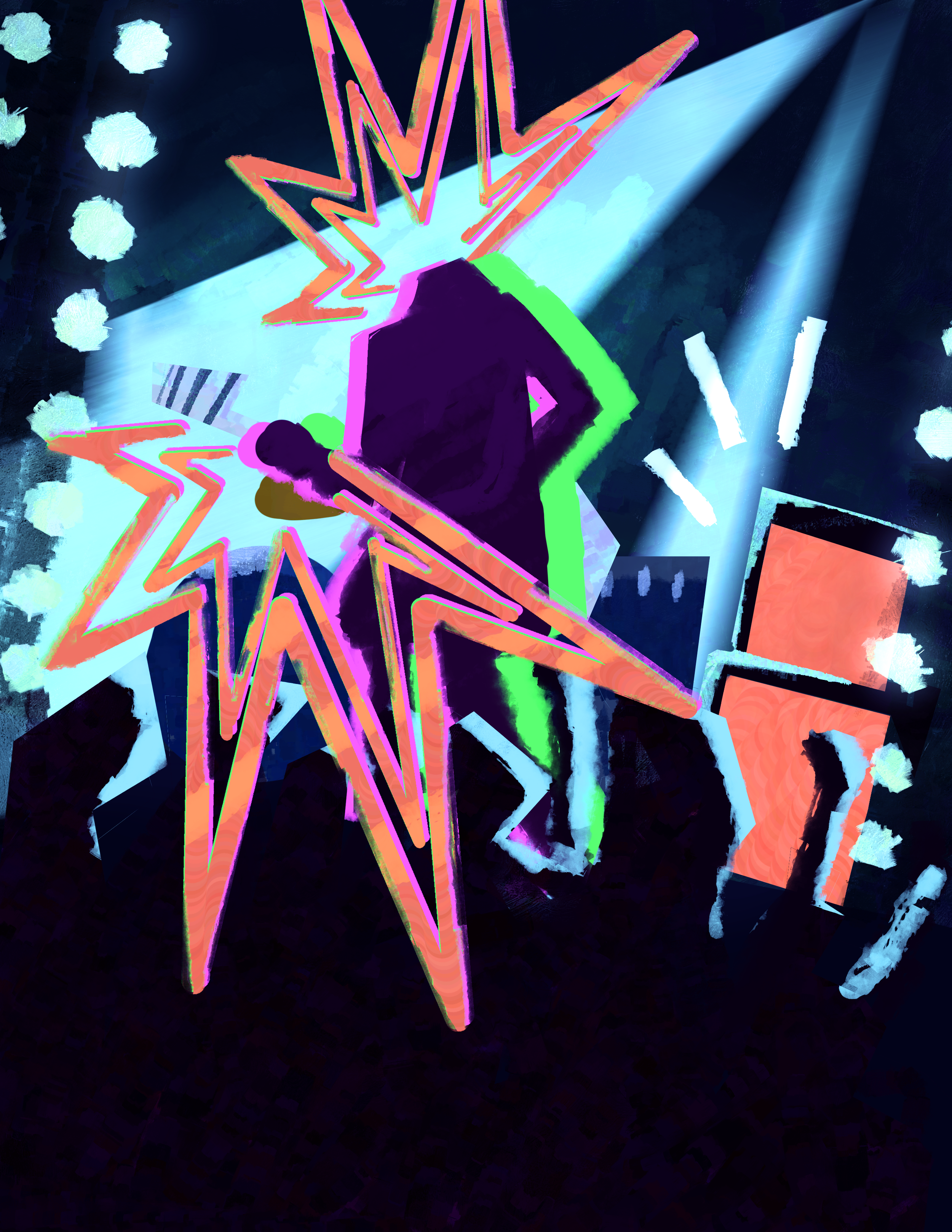
Illustration by Meghan Zhang.
The first memory I have of attending a concert was in December of 2017. I was 11 years old, wearing a pink, glittery “Pretty in Punk” hat, gripping my parents’ hands as we crammed our way in to see The Interrupters at The Opera House venue in Toronto. They were, and continue to be, one of the most crucial bands in shaping my musical identity; with a ska, punk sound and an incredible lead vocalist, Aimee Allen, The Interrupters absolutely blew my mind. It allowed my little out-of-the-box self to feel truly seen in a music-oriented space.
In an era of sanitized algorithms, there is something profoundly radical about the analog unpredictability of a live punk show. Oftentimes, you arrive with the intention of seeing the headliner, only to first be greeted by a group of music nerds in their twenties absolutely shredding on their guitars, and shouting lyrics you can’t quite understand… but you just know you like what they’re saying.
The punk scene acts as a microcosm for the culture of "the opening act". Headliners and venues curate these slots to expose artists to new audiences; a true lifeline in alternative communities . Supporting smaller, local groups keeps the lights on for the next generation of misfits on the scene. Without this, the subculture becomes muted and dull—static, silent, and cold. In a movement deeply rooted in anti-capitalist politics, making space for newer groups is a moral imperative. The more we ignore emerging artists to saturate the hype for a single legacy group, the closer we get to Rage Against The Machine actually becoming the machine.
In 2017, before The Interrupters played their set, I saw The Regrettes as the opener, an openly queer group with a garage-pop-punk sound. At the time, they were performing a punked-up cover of Mariah Carey’s “All I Want for Christmas is You”, but they would go on to release three studio albums before their farewell show in 2023. The Regrettes are not necessarily a group one would expect a hardcore-rocker-dad at this concert to have in his rotation. However, through the art of the opening act, a packed venue was exposed to a vibrant example of the modern queer punk scene. They were given the most valuable commodity in art: an opportunity to be heard.
The histories of “queerness” and “punk” are deeply intertwined. Originally, the term "punk" was used to label those deemed an "other" by society—such as “deviants” engaging in prostitution in the Shakespearean-era. Rather than shrinking from these labels, the punk movement embraced its status in the margins, creating a home for those rejected by the mainstream. Together, queer and punk identities form a powerful alliance against conformity. Through noise and anarchy, they carve out a vital space for self-expression, far removed from the shackles of normative expectations.
There is a quiet magic in being an outlier. For the "freaks and weirdos," music isn't background noise—it’s a homing beacon. In a world that demands we blend until we are merely invisible, these subcultures offer radical permission to be the "other." It is a community built not on the requirement of being the same, but on the grace of being different.
At its core, “alternative” is a broad-stroked sanctuary for the non-conformist—a kaleidoscope of expressions. Whether you are draped in the velvet shadows of goth, fueled by the three-chord rebellion of punk, or finding catharsis in the guttural weight of metal, you are stepping into a shared lineage. These movements were never mere fashion statements; they were
tactics for survival. From the DIY grit of 1970s London, to the basement grunge of the 90s, the "alternative" scene has provided breathing room for those who find the status quo claustrophobic.
I was able to see The Interrupters for a second time a couple years later. Being a little older, I upgraded my sparkly pink ball cap to a simple black fedora – one very similar to what Aimee Allen would often wear onstage. The venue was larger and I got to hear brand new music off of their 2018 album… I truly felt alive. Since then, I have found myself to have quite the affinity for attending local band gigs. There is a specific, volatile chemistry that only exists in a crowded, low-ceilinged bar when you are nineteen years old. You walk through the door as one person and somewhere between the first feedback screech and the final snare hit of a band you’ve never heard of, you decide to become someone else entirely. It is a beautiful, fleeting delusion—the conviction that a forty-minute set can, and will, redraw your entire architecture for the next three months.
If the subculture is the body, the local gig is the heartbeat.
Having grown up as a “band kid” of sorts, I got to see my fair share of friends from my hometown continue to explore their musicality post-secondary. I even have the absolute privilege to say that some of these local bar gigs I’ve been able to attend have featured a band formed by one of my coolest, life-long friends. Being able to grow up and see the way these spaces based in musical subculture have allowed for myself and so many others to feel both seen and thrilled to be involved in a community of such talented folks is truly beautiful – and this is the case for so many music nerds who have never seemed to quite “fit in”.
When you pay that cover charge, you aren't just buying a drink or a song; you are funding a safe house. You are ensuring that the 11-year-old in the glittery hat doesn't just grow up to remember a concert, but grows up to find a home. So, show up early. Watch the openers. Because the moment we stop looking for the next voice from the gutter is the moment the music truly dies.